· By Editorial Team
Prenatal vitamins before pregnancy: a guide for women over 35
Women over 35's preconception nutrition is a food and supplement plan designed to prepare for pregnancy with a clear, provider-guided routine. The best prenatal vitamins before pregnancy fit your nutrient needs, current medicines, and daily habits, not an automatic higher dose because of your age.
TL;DR
- Choose the best prenatal vitamins before pregnancy by folate form, nutrient amounts, and ingredient overlap, not age-based promises.
- CDC recommends 400 mcg of folic acid daily for women who could become pregnant.
- Pink Stork prenatal vitamins offer several formats to compare with your healthcare provider.
- Women over 35 need timely preconception care alongside a consistent prenatal routine.
Why prenatal nutrition matters for women over 35
A prenatal decision often arrives alongside other questions: When should you start? Does your age change the formula you need? Should you keep your current multivitamin?
Age alone is not a reason to double your prenatal dose. Your food intake, health history, medicines, and provider's recommendations deserve more attention than a supplement's age-focused language.
Before you add anything, review your existing bottles. This guide to folate overlap across prenatal supplements explains a useful first check: identify repeated ingredients before you build a routine.
For your 2026 preconception plan, separate two decisions. A prenatal helps you establish a supplement routine, while a preconception appointment addresses your individual medical history and pregnancy plans. Neither decision replaces the other.
The CDC's public guidance recommends 400 mcg of folic acid daily for women who could become pregnant. Its pregnancy-planning guidance advises a start at least 1 month before conception. You do not need a positive pregnancy test before you discuss a prenatal.
How to choose your prenatal before pregnancy
1. Start with a preconception appointment
Use a paper list or your phone's notes to prepare for a visit. Include every prescription, nonprescription medicine, vitamin, tea, and herbal supplement you use, even products you take only occasionally.
Your clinician can assess the whole picture, including previous pregnancies, dietary restrictions, and any relevant test results. You do not need to purchase a large supplement collection before that conversation.
For women over 35, timing also deserves a direct question. The American College of Obstetricians and Gynecologists advises fertility evaluation after 6 months of unsuccessful attempts for women older than 35, with earlier evaluation when medical history warrants it. A prenatal purchase should not postpone that conversation.
For your 2026 appointment, bring specific questions rather than a request for the strongest formula:
- List the products and medicines you currently use.
- Explain when you plan to try for pregnancy.
- Share dietary restrictions and foods you rarely eat.
- Ask when to return if conception has not occurred.
2. Check folate form and label units
Start with the Supplement Facts panel, not the front-label headline. Find the folate entry and read both the amount and the form in parentheses.
Folate and folic acid are related terms, but they are not interchangeable label instructions. Folate is the broader term for vitamin B9. Folic acid is a specific form used in supplements and fortified foods. Some supplements instead list methylfolate.
The NIH Office of Dietary Supplements explains that folate amounts appear in dietary folate equivalents, or DFE. A label's mcg DFE figure is not the same measurement as its folic acid amount. Folate supports normal cell division.†
Because the CDC recommendation specifically names folic acid, ask your provider how a product's folate form and amount fit that guidance. Do not assume that a larger number or a methylated form automatically makes one prenatal the better choice for you.
- Locate the folate amount per full daily serving.
- Read the ingredient form in parentheses.
- Distinguish mcg DFE from mcg of folic acid.
- Ask your provider to confirm the intended daily amount.
3. Compare a prenatal with DHA against your priorities
Once you know what to check, shortlist formulas rather than purchase several at once. Pink Stork, led by founder and CEO Amy Suzanne Upchurch, sells doctor-formulated supplements for women across pregnancy and other life stages.
Pink Stork Total Prenatal + DHA is best for shoppers who want a prenatal multivitamin with DHA in one formula. The supplied product description states that it delivers 100% Daily Value of 14 OBGYN-recommended nutrients. Review the current label to identify those nutrients and their amounts.
Always consult your healthcare provider before starting any new supplement, especially during pregnancy, breastfeeding, or while managing a medical condition.
You can explore the Total Prenatal + DHA formula before pregnancy with your provider. For your 2026 comparison, focus on the full daily serving rather than an isolated ingredient claim.
A formula that combines prenatal nutrients and DHA gives you both within the same product choice. Its practical limitation is that the name and Daily Value statement do not establish whether every nutrient matches your individual needs.
- Read the complete Supplement Facts panel.
- Confirm the amount of DHA per daily serving.
- Check the directions and serving size.
- Compare the formula with your provider's recommendations.
4. Choose a format you can use consistently
Use your experience with supplements as a guide. If a capsule routine has been difficult, compare a chewable or liquid format before you commit to another bottle.
A different format is not automatically a different level of nutritional quality. Compare the actual nutrient list, directions, and full serving. Do not transfer assumptions about one prenatal to another simply because both use the word prenatal.
Choose the format and the formula together. A product that suits your preferences still needs the nutrient profile your provider recommends. Likewise, a formula that looks appropriate on paper needs directions you can realistically follow.
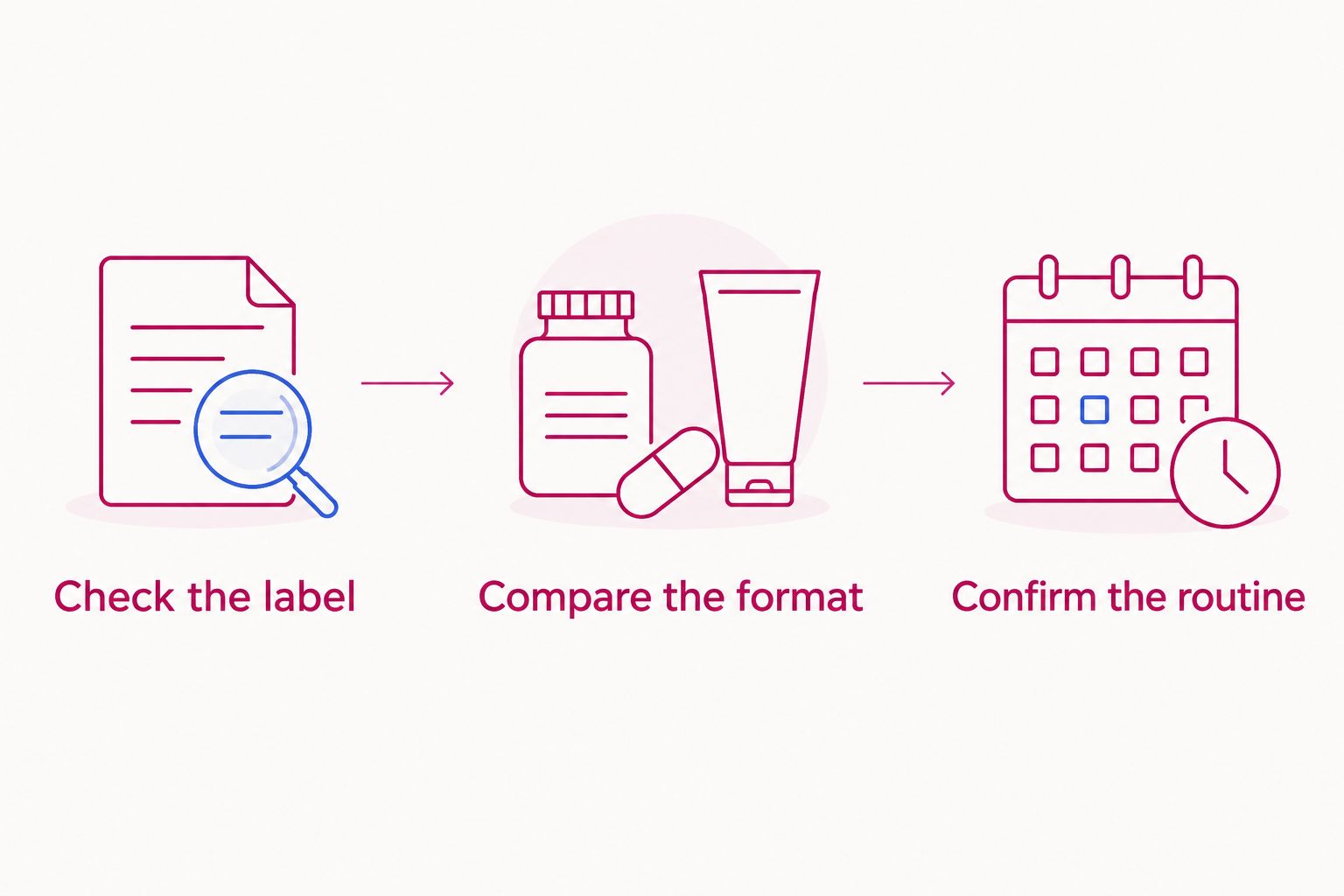
A simple decision sequence keeps this manageable: check the label, compare the format, then confirm the routine with your provider.
- Check the label: Compare nutrients per full serving.
- Compare the format: Decide whether capsules, gummies, or liquid suit you.
- Confirm the routine: Read the directions before purchase.
- Note ingredient restrictions that matter to you.
Compare prenatal options before your first purchase
These options serve different format preferences. For a 2026 purchase, check the current product label rather than assume the formulas contain identical nutrients or amounts.
| Option | Best for | Verified formulation detail | Key limitation to check |
|---|---|---|---|
| Total Prenatal + DHA | Shoppers who want a prenatal multivitamin with DHA in one formula | Product description states 100% Daily Value of 14 OBGYN-recommended nutrients | Review the full label for individual nutrient amounts and serving directions |
| Premium Prenatal + DHA Gummies for a chewable routine | Shoppers who prefer a chewable prenatal | Described as a chewable prenatal with essential nutrients, including folate | Do not assume its nutrient list or amounts match another prenatal |
| Liquid Prenatal + Postnatal for a liquid routine | Shoppers who prefer a liquid prenatal | Product description states 100% of 16 vitamins recommended by OBGYNs | Check measured-serving directions and the complete nutrient panel |
No format wins for every woman over 35. The useful comparison is whether the current label and daily directions fit the plan you discussed with your provider.
Explore prenatal formats


5. Review food intake before you add separate nutrients
Write down your usual meals before you shop for additional supplements. You do not need a perfect food diary. A short record helps your provider or registered dietitian understand what your prenatal sits alongside.
Choline offers a useful example of why this matters. The NIH Office of Dietary Supplements lists an adequate intake of 425 mg daily for adult women and 450 mg daily during pregnancy. Those are total-intake references, not instructions to add that amount as a separate supplement.
Foods such as eggs, meat, fish, soybeans, and beans contribute choline. Your provider can help you compare your food intake with the amount on a prenatal label.
The same principle applies to other nutrients: review the whole plan before you add another bottle. A nutrient's importance does not mean everyone needs it as a separate product.
- Record the foods you eat regularly.
- Note food groups you avoid.
- Compare label amounts with your provider's recommendations.
- Ask about a separate nutrient only after that review.
6. Check for overlap across your supplement shelf
Place every supplement label side by side. A prenatal, everyday multivitamin, beauty supplement, and individual nutrient can share ingredients even when their front labels describe different purposes.
More products do not automatically make a more appropriate preconception plan. Check whether your prenatal will replace your everyday multivitamin rather than assume you should take both.
Count nutrients per daily serving, not per capsule or gummy unless that is the full serving. If one label uses a different unit, ask a pharmacist or clinician to help with the comparison instead of adding unlike figures.
Keep herbal teas and fertility supplements on the same list. A product intended for the months before conception does not automatically belong in a pregnancy routine. Ask when to reassess it, particularly if your pregnancy plans or medicines change.
- Identify repeated folate, iron, and vitamin D entries.
- Include occasional supplements and herbal products.
- Compare complete daily servings.
- Confirm what to discontinue, continue, or reassess with your provider.
7. Build a routine you can maintain
Begin with a simple reminder attached to an established daily habit. Follow your chosen product's directions and any instructions from your provider or pharmacist.
Keep the original container and label available, even if you use a separate organizer. You will want the directions, ingredients, and lot information if you have a product question.
If a prenatal is difficult to take, ask about timing, format, or another appropriate formula. You do not need to force a routine that repeatedly fails. Do not double the next dose after a missed serving unless a healthcare professional specifically directs you to do so.
Plan another label review when your circumstances change, such as a new medicine, a positive pregnancy test, or a provider recommendation. A routine should be consistent without becoming automatic when your needs change.
- Use a daily reminder that suits your schedule.
- Follow the label's serving directions.
- Keep the original label accessible.
- Contact your provider about persistent tolerance concerns.
Common prenatal mistakes women over 35 make
Assume age requires a stronger formula
Your age is relevant to preconception care, but it does not establish a personal supplement dose. Choose from your health history, diet, and provider's advice rather than an age-based promise.
A larger nutrient amount is not a substitute for a more individualized conversation.
Wait for a positive test to ask about a prenatal
Preconception is the right time to review your routine. The CDC's guidance includes folic acid before conception, so bring the question to your provider while you plan for pregnancy.
If you are already pregnant, contact your provider now rather than worry about an ideal timeline you cannot change.
Treat a prenatal as a fertility timeline
A prenatal does not tell you when conception will occur. Keep your provider's follow-up timeline separate from your supplement routine, especially when age or medical history makes timely evaluation important.
Do not postpone an appointment because you want to finish a bottle first.
Choose by one featured ingredient
DHA, folate, or another featured nutrient can help narrow your questions, but the complete formula still matters. Read the full serving, check overlap, and consider whether the format works for you.
A thoughtful first purchase starts with the whole label, not the largest front-label number.
FAQ
What are the best prenatal vitamins before pregnancy if I'm over 35?
The best prenatal vitamins before pregnancy match your nutrient needs, medicines, and daily routine. Age alone does not establish a higher dose, so compare the full label with your healthcare provider.
When should I start a prenatal before I try to conceive?
Discuss a prenatal before you start attempts to conceive. The CDC advises 400 mcg of folic acid daily and a start at least 1 month before conception as part of pregnancy preparation.
Do women over 35 need extra folic acid?
Age over 35 alone does not establish a need for extra folic acid. Your healthcare provider should set any individualized recommendation based on your medical history and current medicines.
Is methylfolate the same as folic acid on a prenatal label?
Methylfolate and folic acid are different forms of folate. Because the CDC recommendation specifically names folic acid, ask your provider how your chosen formula fits that guidance.
Can I take my regular multivitamin with a prenatal?
Do not assume you should take both, because the formulas can contain overlapping nutrients. Bring both labels to your provider or pharmacist and confirm which product belongs in your routine.
Are prenatal gummies better than liquid prenatal vitamins?
Neither format is automatically better. Compare the complete nutrient panel, daily serving, ingredient restrictions, and the format you can use consistently.
Does a prenatal with DHA mean I need no other supplements?
A prenatal with DHA does not establish whether you need any separate nutrients. Your provider can review the full label alongside your diet and individual recommendations.
When should I ask about fertility evaluation after 35?
ACOG advises fertility evaluation after 6 months of unsuccessful attempts for women older than 35. Your clinician can recommend an earlier evaluation based on your history or other concerns.
One last thing
The most useful item to bring to your appointment is a photo of the complete Supplement Facts panel. A product name cannot show your provider the nutrient amounts, forms, or daily serving.
As you prepare for pregnancy in 2026, give yourself permission to start simply. Explore Pink Stork's prenatal options, compare the current labels, and choose a suitable first purchase with your healthcare provider. You do not need to build the entire routine at once.
Related guides
† These statements have not been evaluated by the Food and Drug Administration. This product is not intended to diagnose, treat, cure, or prevent any disease. Always consult your healthcare provider before starting any new supplement, especially during pregnancy, breastfeeding, or while managing a medical condition. Keep out of reach of children.