· By Editorial Team
Best myo-inositol supplements for fertility in 2026
The best myo inositol supplement is the one whose formula and dose fit your healthcare provider's plan, not simply the one with the most familiar ratio. This 2026 guide compares Pink Stork's two myo-inositol options and explains where a prenatal vitamin fits before pregnancy.
TL;DR
- Choose a myo inositol supplement by its full label and your provider's advice, not its ratio alone.
- Pink Stork offers both 40:1 and 3.6:1 myo-inositol and D-chiro-inositol formulas.
- Total Prenatal + DHA serves a different purpose from a targeted inositol supplement.
- Review your prenatal vitamins and fertility supplements together before you add another product.
Why this matters before pregnancy
You want to make a thoughtful choice before pregnancy, but supplement labels can turn a simple purchase into a long list of questions. What does the ratio mean? Does a larger number mean more support? Does an inositol supplement replace your prenatal?
Pink Stork's myo-inositol options are best suited to women who want a clearly named ratio to discuss with their healthcare provider. The useful comparison starts with the formula, then moves to the amount per serving and your existing supplement routine.
Always consult your healthcare provider before starting any new supplement, especially during pregnancy, breastfeeding, or while managing a medical condition.
Myo-inositol options at a glance
For your 2026 comparison, start with the distinction each product actually makes. The two inositol formulas have different named ratios. The prenatal is a separate category, not a third inositol option.
| Product | Best for | Verified distinction | What to confirm before purchase |
|---|---|---|---|
| 40:1 Ratio Myo-Inositol + D-Chiro-Inositol for a provider-guided plan | Women whose provider recommends a 40:1 ratio | Combines myo-inositol and D-chiro-inositol in a named 40:1 ratio | Amounts per serving, label directions, and fit with your current supplements |
| 3.6:1 Ratio Myo + D-Chiro-Inositol for a different ratio preference | Women whose provider recommends a 3.6:1 ratio | Combines myo-inositol and D-chiro-inositol in a named 3.6:1 ratio | Amounts per serving and the reason your provider prefers this ratio |
A ratio describes the relationship between two ingredients. It does not tell you the total amount in a serving, establish a personal dose, or promise a fertility outcome.
What makes a suitable myo inositol supplement?
Use these criteria before you choose a bottle. They keep your decision focused on information you can verify rather than a general best-supplement claim.
- Clear ingredient identity: Look for the names myo-inositol and D-chiro-inositol rather than an unexplained reference to inositol.
- A named ratio: Match the ratio to your provider's recommendation instead of an online preference.
- Amounts per serving: Read the quantity of each ingredient, not just the front-label ratio.
- Practical label directions: Check how the stated serving fits your day without inventing your own schedule.
- A coordinated prenatal plan: Review the full ingredient list alongside your prenatal and any other fertility supplements.
- A follow-up plan: Know whom to contact with questions and when your provider wants to revisit the choice.
For a 2026 purchase, use the current label. A saved screenshot or an older shopping note is not a substitute for the information on the product you select.
Understand the ratio before you compare formulas
Myo-inositol and D-chiro-inositol are two forms of inositol. When both appear in a formula, the ratio describes their relative amounts, not the number of servings or the total daily dose.
A 40:1 ratio means 40 parts myo-inositol for every 1 part D-chiro-inositol. A 3.6:1 ratio means 3.6 parts myo-inositol for every 1 part D-chiro-inositol. Those are proportions, not instructions for how much you should take.
The ratio and the dose answer different questions. The ratio tells you how the ingredients relate to each other. The dose tells you the amount you would take under the label directions and your provider's guidance.
Two bottles can display the same ratio without providing the same amount per serving. Likewise, a larger ratio number does not establish that a product is more concentrated overall or better suited to you.
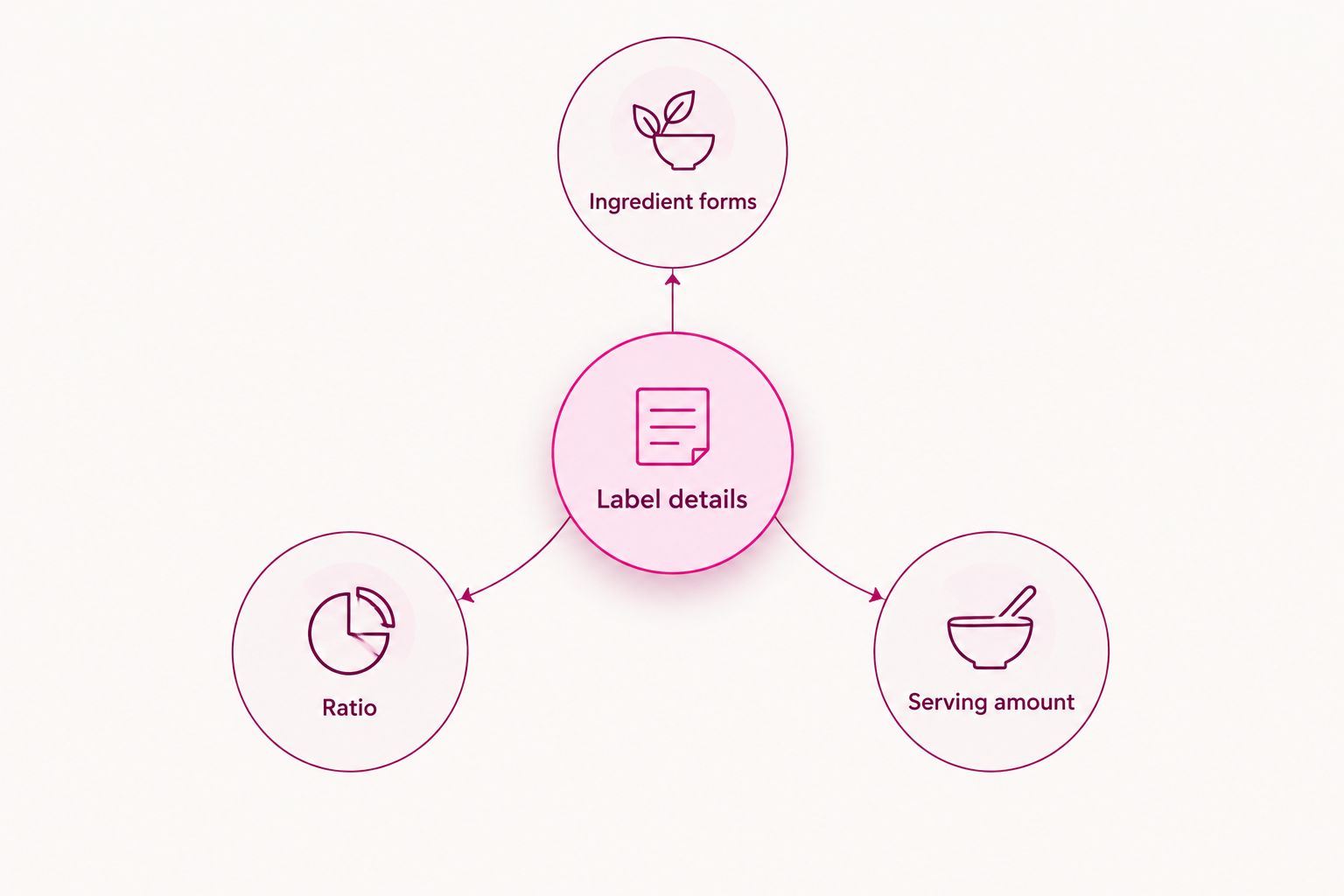
Separate these three label details:
- Ingredient forms: Which types of inositol does the product contain?
- Ratio: How do the amounts of those forms compare?
- Serving amount: How much of each ingredient does the stated serving provide?
When the 40:1 formula fits your conversation
Best for: a provider-recommended 40:1 ratio
The 40:1 Ratio Myo-Inositol + D-Chiro-Inositol formula gives you a specific option to discuss when your provider names that ratio. Its product name identifies both forms of inositol and their relative proportion.
The product description identifies support for ovarian function and menstrual cycles.† Keep those structure/function benefits separate from a promise about conception. A supplement description does not establish your chance of pregnancy or a timeline for results.
What makes this option useful:
- Both inositol forms appear in the product name.
- The named ratio gives you a clear reference for a provider discussion.
- A targeted formula lets you assess inositol separately from your prenatal-vitamin choice.
What to confirm:
- The ratio alone does not provide your serving amount.
- Your provider still needs the full label to assess how the formula fits your plan.
If your appointment notes say only myo-inositol, ask whether your provider intended this combination and ratio. That question is more useful than an assumption based on a familiar product name.
Your next move: choose this ratio when it matches your provider's specific recommendation.
When the 3.6:1 formula fits your conversation
Best for: a provider-recommended 3.6:1 ratio
The 3.6:1 Ratio Myo + D-Chiro-Inositol formula offers a different proportion of the same two named inositol forms. Compared with 40:1, it has a greater relative proportion of D-chiro-inositol, but the actual quantity still depends on the serving amount.
Its product description also identifies support for ovarian function and menstrual cycles.† A shared benefit description does not make the formulas interchangeable for your individual plan.
What makes this option useful:
- The product name states the ratio directly.
- Both inositol forms are identified.
- It provides a distinct option when your provider specifies a different proportion.
What to confirm:
- A different ratio is not, by itself, evidence of a better personal fit.
- A switch from another formula requires a review of amounts, not just product names.
Ask your provider to explain the reason for this ratio in plain language. You should leave the conversation with a clear product choice, directions, and a plan for questions, not a need to interpret the numbers yourself.
Your next move: choose this option when your provider recommends the 3.6:1 ratio for your plan.
Keep your prenatal vitamin in the conversation
Best for: a separate prenatal-vitamin decision
An inositol supplement and a prenatal vitamin are different product categories. Do not treat a targeted inositol formula as a replacement for the prenatal your healthcare provider recommends.
Total Prenatal + DHA deserves a place in that discussion. Its product description states that it delivers 100% Daily Value of 14 OBGYN-recommended nutrients. That is a specific formulation detail, not a claim that every nutrient you need appears at your individual required amount.
The NIH Office of Dietary Supplements explains nutrient requirements through its nutrient-specific fact sheets, including folate, iron, iodine, and choline. Use those educational resources for nutrient context, then ask your provider to interpret your complete prenatal label for you.
What makes a prenatal review useful:
- You assess your prenatal separately from a targeted supplement.
- You can compare the full ingredient lists in one appointment.
- You can identify repeated ingredients before you add another bottle.
What to confirm:
- A Daily Value percentage is not a personalized supplement prescription.
- A prenatal product name does not answer every question about your diet or other supplements.
For your 2026 routine, start with a prenatal discussion rather than an ever-longer supplement list. Then decide whether a targeted inositol formula belongs beside it.
Explore the formulas after your label review
Once you and your provider have identified the product category and ratio, compare the current product details. Keep your notes beside you so the choice reflects the plan you discussed.
Compare the relevant formulas


A practical checklist before your first purchase
You do not need to arrive at your appointment with all the answers. Bring the details that let your provider give you a specific recommendation.
Gather your labels
Take clear photos of the Supplement Facts panels and directions for every supplement you use. Include your prenatal, separate nutrients, teas, and other fertility products. Add your medication list, too.
Product names alone leave out important information. Your provider needs the ingredient amounts and directions, especially when more than one product contains the same nutrient or ingredient.
Ask for a specific recommendation
Ask whether an inositol supplement belongs in your current plan. If the answer is yes, ask which ingredient forms, ratio, and serving directions your provider recommends.
Write down the answer in your own words. If a label does not match those notes, pause and clarify before you order rather than choose the closest-looking option.
Agree on follow-up
Ask when to check in and what information your provider wants you to record. Also ask what to do if you miss a serving, notice an unwanted effect, or have a change in your medication list.
If you become pregnant, contact your provider to review the supplement plan. A choice made before conception should not become an automatic decision for every later stage.
Keep one current list
Save your agreed supplement list with the date of your 2026 review. Update it when a product changes, and bring it to your next visit. A simple list is easier to use than scattered purchase confirmations and screenshots.
Which option should you choose?
Start with your prenatal plan, then choose an inositol ratio only when you have a clear reason for that choice. If your provider specifies 40:1, review the corresponding formula. If your provider specifies 3.6:1, review that formula instead.
This guide compares product roles, named ratios, and verified formulation details. It does not rank one ratio above the other for conception, because a product-to-product fertility outcome comparison is not established here.
Your best next step is a decision you can explain: this is the recommended formula, this is the serving direction, and this is when the plan gets reviewed.
FAQ
What's the best myo inositol supplement for me?
The best fit is a formula whose ingredient forms, ratio, and serving amount match your healthcare provider's recommendation. Pink Stork offers 40:1 and 3.6:1 options to review against that plan.
Is a 40:1 ratio better than a 3.6:1 ratio?
The ratio alone does not establish which formula is better for you. Ask your provider to compare the actual ingredient amounts and explain the reason for the recommended ratio.
What does 40:1 mean on an inositol label?
A 40:1 ratio means 40 parts myo-inositol for every 1 part D-chiro-inositol. It describes proportion, not the total serving amount or a personal dose.
Can a myo-inositol supplement replace my prenatal vitamin?
Do not replace your provider-recommended prenatal with an inositol supplement. A targeted inositol formula and a prenatal vitamin are different product categories, so review their roles separately.
How much myo-inositol should I take?
Ask your healthcare provider for directions based on the exact product label and your circumstances. A ratio does not tell you how much of either ingredient a serving contains.
Can I take inositol with Total Prenatal + DHA?
Have your healthcare provider review both complete labels before you combine them. Include other supplements and medications in that review rather than assess the two products in isolation.
Should I continue my fertility supplements after a positive pregnancy test?
Contact your healthcare provider to review your supplements after a positive pregnancy test. Do not assume that every preconception product belongs in your pregnancy routine.
One last thing
The most useful detail to bring to your appointment is the back label, not just the ratio on the front. A clear photo gives your provider the amounts, serving information, and ingredient list needed for a more specific conversation.
When you are ready, explore the Pink Stork formula that matches that conversation. Keep Total Prenatal + DHA part of your prenatal discussion, and take the next step with clear information rather than pressure to build a larger routine.
Related guides
- Myo-inositol questions for your provider follow-up
- Folate overlap between prenatal vitamins and other supplements
† These statements have not been evaluated by the Food and Drug Administration. This product is not intended to diagnose, treat, cure, or prevent any disease. Always consult your healthcare provider before starting any new supplement, especially during pregnancy, breastfeeding, or while managing a medical condition. Keep out of reach of children.