· By Editorial Team
How do you check folate overlap across prenatal supplements?
To check folate overlap across methylated prenatal vitamins and other supplements in 2026, compare each label’s folate form, amount per serving, and the servings you actually take. Add amounts expressed in the same units, keep any listed folic acid amount separate, and ask your healthcare provider to review the combined plan before you add another folate product.
TL;DR
- Compare methylated prenatal vitamins by folate form, mcg DFE, and actual daily servings, not front-label wording.
- Pink Stork Total Prenatal + DHA belongs on your label checklist before you consider separate folate.
- Record folic acid separately from total folate expressed in dietary folate equivalents.
- Ask your healthcare provider to review every supplement together before you add or replace a product.
Why this matters
You do not need to guess whether two bottles repeat the same nutrient. A prenatal, a multivitamin, and a separate folate supplement can each contribute folate, even when their front labels describe different purposes.
If you are considering Total Prenatal + DHA as your prenatal vitamin, start with its current Supplement Facts panel. Then compare that panel with every other supplement you take, rather than assume a separate product fills a gap.
Always consult your healthcare provider before starting any new supplement, especially during pregnancy, breastfeeding, or while managing a medical condition.
Pink Stork prenatal supplements are best for readers who want to choose among the brand’s prenatal options with their healthcare provider. A clear label review helps you make that choice without an unnecessary duplicate.
How do you check folate overlap across prenatal supplements?
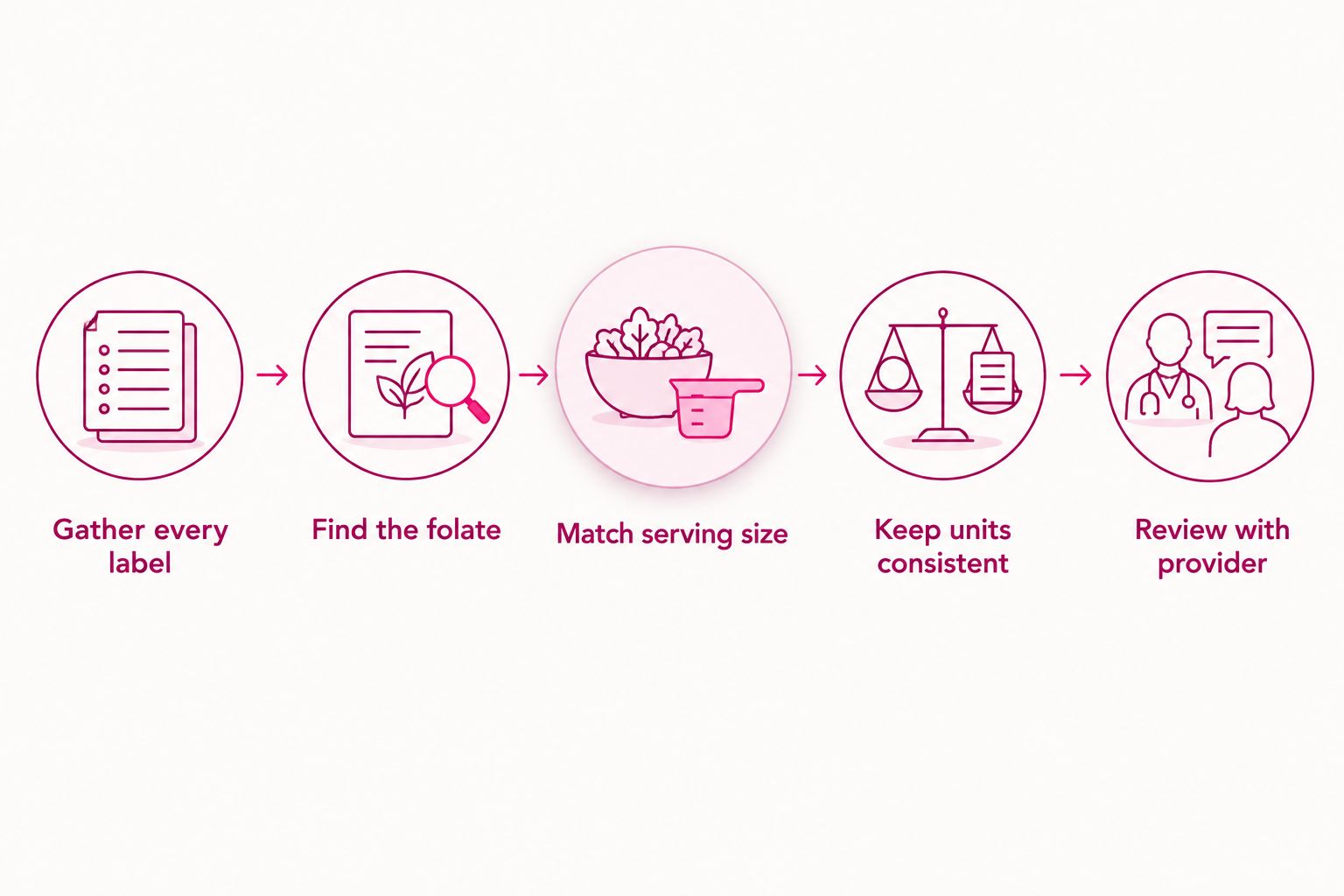
Use the same checklist for every bottle. The goal is a complete record of your intake, not a self-prescribed folate target.
1. Gather every label
Put your prenatal, multivitamin, B-complex, separate folate, and any other supplements on one surface. Include powders, gummies, liquids, and products you take only on certain days.
Check the Supplement Facts panel rather than rely on the product name. A product’s purpose does not tell you whether it contains folate, and a familiar bottle does not replace a current label check.
For each product, write down:
- Exact product name.
- Serving size.
- Folate amount and unit.
- Folate form shown on the label.
- Any separate folic acid amount in parentheses.
- Your actual daily dose or weekly schedule.
2. Find the folate row
Look for “Folate” in Supplement Facts. Then copy the full line, including the wording in parentheses, rather than shorten it to a single number.
Folate is the nutrient category. Folic acid and methylfolate are forms you can encounter on supplement labels. Methylfolate can also appear as L-5-MTHF or L-5-methyltetrahydrofolate, so different words do not necessarily mean different nutrients.
A methylated form still belongs in your folate inventory. Do not leave it out simply because another label uses the word folic acid.
3. Match the serving size to your actual use
The amount on Supplement Facts refers to the listed serving, not automatically to one capsule or gummy. Read the serving size first, then compare it with the amount you take.
If your actual use differs from the label directions, record both. Ask your provider to review the difference rather than change the serving to make the folate total look right.
For a liquid or powder, note the stated measurement and the measuring tool you use. A record that says only “one dose” leaves your provider without enough detail to check the amount.
4. Keep the units consistent
DFE means dietary folate equivalents. It accounts for differences in how forms and sources of folate are absorbed, which is why a DFE figure is not interchangeable with every other folate figure on a label.
Add the amounts labeled mcg DFE to other amounts labeled mcg DFE. Record any listed folic acid amount in its own column. Do not add a DFE figure and the parenthetical folic acid figure from the same serving as though they were separate ingredients.
The metric conversion is straightforward: 1 mg equals 1,000 mcg. That conversion changes the unit size, not the folate form or the meaning of DFE.
5. Separate alternatives from add-ons
Compare products according to their intended place in your routine. A prenatal choice and a separate folate product answer different questions, and neither product name alone establishes whether you need both.
| Product | Best for this comparison | What the supplied product information establishes | What to check before a decision |
|---|---|---|---|
| Total Prenatal + DHA | Readers who want to evaluate a prenatal formula first | A prenatal product whose description lists 100% Daily Value of 14 OBGYN-recommended nutrients | Current folate form, amount, serving size, and overlap with your other products |
| Methylated Folate for a separate folate discussion | Readers whose provider has identified a reason to consider separate folate | A standalone methylated folate product | Whether your existing prenatal already supplies the amount your provider wants you to take |
The practical advantage of a prenatal formula is that you can review multiple nutrients in one product. The trade-off is that you need to check the whole formula, not just folate, before you add another multivitamin.
A separate folate product lets your provider consider that nutrient independently. It also creates another possible source of overlap, so it belongs in the same review as your prenatal, not outside it.
6. Bring the complete record to your provider
Send photographs of each Supplement Facts panel along with your actual schedule. Include prescribed supplements and any individual instructions you have already received.
Ask for a clear plan: which prenatal to use, whether separate folate has a role, and what to stop when you switch products. The useful outcome is one agreed routine, not simply a higher total.
Once you understand the different roles, you can explore Pink Stork’s prenatal and separate folate options with a more focused question for your provider. The products below are options to review, not a recommendation to take them together.
Options to review with your provider


Why folate totals vary across supplements
Two folate labels can look different without either label being wrong. These are the details that explain the difference and deserve a place in your 2026 label review:
- Folate form: Folic acid and methylfolate are different forms of the same nutrient category. Copy the form instead of treating the names as unrelated nutrients.
- Unit wording: A figure in mcg DFE and a figure in mcg folic acid describe different aspects of the label. Preserve both descriptions.
- Serving size: A listed serving can contain more than one capsule or gummy. The nutrient amount applies to that complete serving.
- Actual schedule: Daily use and occasional use produce different intake records. Write down what you actually take.
- Product combination: A prenatal plus another multivitamin creates a different review from a prenatal alone. Include the full combination.
- Personal instructions: A provider-directed plan can differ from general label directions. Keep those instructions with your product list.
These differences explain why front-label percentages do not settle the overlap question. Your provider needs the amount, form, and schedule together.
What do mcg DFE and the folic acid limit mean?
The NIH Office of Dietary Supplements’ Folate Fact Sheet for Health Professionals lists a pregnancy recommended dietary allowance of 600 mcg DFE per day. This is a total dietary reference amount, not an instruction to obtain that amount from each supplement or to add another product whenever a bottle looks different.
For adults age 19 and older, including during pregnancy, the same NIH reference lists an upper limit of 1,000 mcg per day of folic acid from supplements and fortified foods. That limit does not refer to naturally occurring food folate, and it should not be compared directly with a total expressed in mcg DFE.
The NIH fact sheet also explains that formal conversion factors between mcg and mcg DFE have not been established for supplemental 5-MTHF. Do not invent your own methylfolate conversion or use the folic acid limit as permission to add more methylfolate.
For your 2026 supplement review, keep these reference values separate from product facts. The bottle tells you what a product supplies. Your healthcare provider interprets that information alongside your food intake, other supplements, and individual care plan.
Can you add the folate Daily Value percentages together?
Daily Value percentages are a quick comparison aid, not a complete personal dose assessment. The FDA explains that percent Daily Value describes how much a nutrient in a serving contributes to a daily diet, and label reference values can depend on the population for which the product is labeled.
Use the amount in mcg DFE for your written comparison, and keep the percentage as a secondary detail. Do not assume that matching percentages on two different products prove that their amounts or intended users match.
When you ask your provider about a 2026 prenatal purchase, send the full panel rather than a photo of only the percentage. That extra context preserves the serving size, nutrient form, and label instructions.
Should you take a prenatal and a separate folate supplement together?
A prenatal and separate folate supplement need a combined label review before you decide to use both. Neither the phrase “methylated prenatal vitamins” nor a standalone folate label establishes a personal need for an additional dose.
Ask your provider what the second product adds to your existing plan. If you already received individual instructions, bring those instructions to the review rather than replace them with general information from an article.
Does a different folate name mean there is no overlap?
Different folate names do not rule out overlap. A prenatal that lists methylfolate and another product that lists folic acid both belong in your folate record, with their forms identified separately.
Keep the full label wording intact. Your provider can interpret the combination more accurately when the record preserves the distinctions instead of collapsing everything into an unlabeled total.
What should you do when you switch prenatal products?
A prenatal switch deserves a fresh comparison before the new bottle becomes part of your routine. Put the old and new labels side by side, identify any separate supplements you plan to keep, and ask when the new routine should begin.
Do not assume you should finish both prenatals together. A transition plan should also account for nutrients other than folate, since two prenatal formulas can repeat several ingredients.
FAQ
How do I check methylated prenatal vitamins for folate overlap?
Compare every product’s folate form, amount in mcg DFE, serving size, and your actual daily use. Keep any listed folic acid amount separate and ask your healthcare provider to review the full combination.
Is methylfolate the same thing as folic acid?
Methylfolate and folic acid are different forms of folate. Both belong in a folate inventory, but you should preserve their form names and label units rather than treat every number as interchangeable.
Does my prenatal already contain folate?
Check the folate row on your prenatal’s current Supplement Facts panel. The product name alone does not establish the amount or form in the bottle you use.
Can I add mcg DFE and mcg folic acid together?
Do not add mcg DFE and mcg folic acid as though they were the same measurement. Record DFE amounts together and keep the listed folic acid amount in a separate column for your provider.
How much folate is the general pregnancy reference amount?
The NIH Office of Dietary Supplements lists a pregnancy recommended dietary allowance of 600 mcg DFE per day. That is a total dietary reference amount, not a recommendation to obtain that amount from every supplement.
Does the adult folic acid upper limit apply directly to methylfolate?
The adult upper limit of 1,000 mcg per day is stated for folic acid from supplements and fortified foods, not as an interchangeable methylfolate dose. Ask your provider to interpret methylfolate amounts rather than use that limit to choose an additional dose.
Should I bring food and drink labels to my folate review?
Include regularly consumed fortified foods and drinks when your provider reviews folic acid intake. They can contribute folic acid in addition to the amounts in your supplements.
Can I take two prenatal vitamins while I finish an old bottle?
Ask your provider for a transition plan instead of assuming the two prenatal formulas belong together. Compare both complete labels because overlap can extend beyond folate.
One last thing
The most useful detail is often the small parenthetical text beside the folate amount. It can distinguish a nutrient form or folic acid amount from the larger DFE figure, so do not crop it out of your label photo.
For your next 2026 purchase, save the current label and keep it with your provider’s instructions. You will have a clear reference when another supplement catches your attention or your prenatal routine changes.
When you feel ready, explore Pink Stork’s prenatal options and bring your preferred formula to that conversation. You deserve a choice that fits an agreed plan, without pressure to add more.
Related guides
- Folate supplements for pregnancy: questions for your product review
- Methylated B12 on a prenatal label
† These statements have not been evaluated by the Food and Drug Administration. This product is not intended to diagnose, treat, cure, or prevent any disease. Always consult your healthcare provider before starting any new supplement, especially during pregnancy, breastfeeding, or while managing a medical condition. Keep out of reach of children.