· By Editorial Team
How much choline do you need during pregnancy?
During pregnancy, aim for 450 mg of choline per day in 2026, counting food and supplements together, according to the National Institutes of Health Office of Dietary Supplements. That is a total daily intake target, not an instruction to take a 450 mg supplement. When you compare choline prenatal vitamins, check the amount of choline per serving rather than assume your prenatal provides the full amount.
TL;DR
- Pregnancy calls for 450 mg of choline daily from food and supplements combined, according to NIH guidance.
- Compare choline prenatal vitamins by milligrams per serving, not the product name or front label.
- Pink Stork offers doctor-formulated prenatal vitamins for women who want a prenatal option to discuss with their provider.
- A separate choline supplement requires a review of your prenatal, food intake, and other supplements.
If you are considering Total Prenatal + DHA for your prenatal routine, use its current Supplement Facts panel as your starting point. A broad prenatal formula and your choline intake deserve separate checks.
Always consult your healthcare provider before starting any new supplement, especially during pregnancy, breastfeeding, or while managing a medical condition.
How much choline do you need during pregnancy?
The pregnancy target is 450 mg per day from all sources combined. The NIH Office of Dietary Supplements identifies this amount as an Adequate Intake, or AI. It is a nutrition reference value, not a personalized prescription or a required supplement dose.
For your 2026 prenatal review, use these NIH reference amounts:
| Life stage | Daily choline Adequate Intake | What the amount includes |
|---|---|---|
| Adult women who are not pregnant or breastfeeding | 425 mg per day | Food, beverages, and supplements |
| Pregnancy | 450 mg per day | Food, beverages, and supplements |
| Breastfeeding | 550 mg per day | Food, beverages, and supplements |
These reference values help you evaluate your overall intake. Your healthcare provider can explain how they apply to your diet, life stage, and medical history.
The distinction matters: a prenatal with less than 450 mg of choline does not automatically leave you below the pregnancy target. Food contributes too. At the same time, the word prenatal does not establish how much choline a formula contains.
Why this matters
Choline supports normal cell membrane structure and nervous system function.† During pregnancy, choline also supports normal fetal brain development.† These nutrient roles do not mean a particular supplement guarantees a developmental outcome.
The practical question is not whether a prenatal has an impressive nutrient list. It is whether you understand what your meals and supplements provide together.
You do not need to guess from the front of a bottle. Start with the daily target, read the nutrient amount, and bring any questions to your prenatal appointment.
Pregnancy: 450 mg of choline per day
The 450 mg daily pregnancy target applies to your total intake. Do not treat it as an amount you must add on top of whatever you already eat and take.
Eggs, meat, fish, dairy foods, soybeans, beans, and some vegetables contribute choline. The amount depends on the food and portion. A food record gives your provider or registered dietitian more useful information than a general description such as “I eat a balanced diet.”
Keep your usual meals in view. If you eat eggs regularly, include them in the assessment. If you avoid eggs, meat, or dairy, record the foods you eat instead rather than assume that your intake must be inadequate.
Your goal is a realistic picture of your routine, not a perfect food diary. A prenatal label alone cannot describe your total daily choline intake.
Breastfeeding: 550 mg of choline per day
The 550 mg daily breastfeeding target is higher than the pregnancy target. Revisit your nutrient plan after delivery rather than assume every part of your pregnancy routine should stay the same.
A product name such as prenatal or postnatal does not replace a nutrient-by-nutrient review. Check the current label and discuss your meals, supplements, and feeding plans with your provider.
You do not have to settle every postpartum nutrition question before birth. Put choline on the list for your postpartum visit so the change in reference intake does not get overlooked.
Before pregnancy: 425 mg of choline per day
For adult women who are not pregnant or breastfeeding, the NIH Adequate Intake is 425 mg per day. If you plan to conceive, a preconception visit is a useful time to review your food intake and prenatal choice together.
Do not interpret the change from 425 mg to 450 mg as a reason to manage choline in isolation. Your provider can review it alongside the other nutrients in your prenatal plan.
The same basic method applies before and during pregnancy: identify the relevant reference amount, count your sources, and ask about any gap before you add another product.
How do you check choline prenatal vitamins?
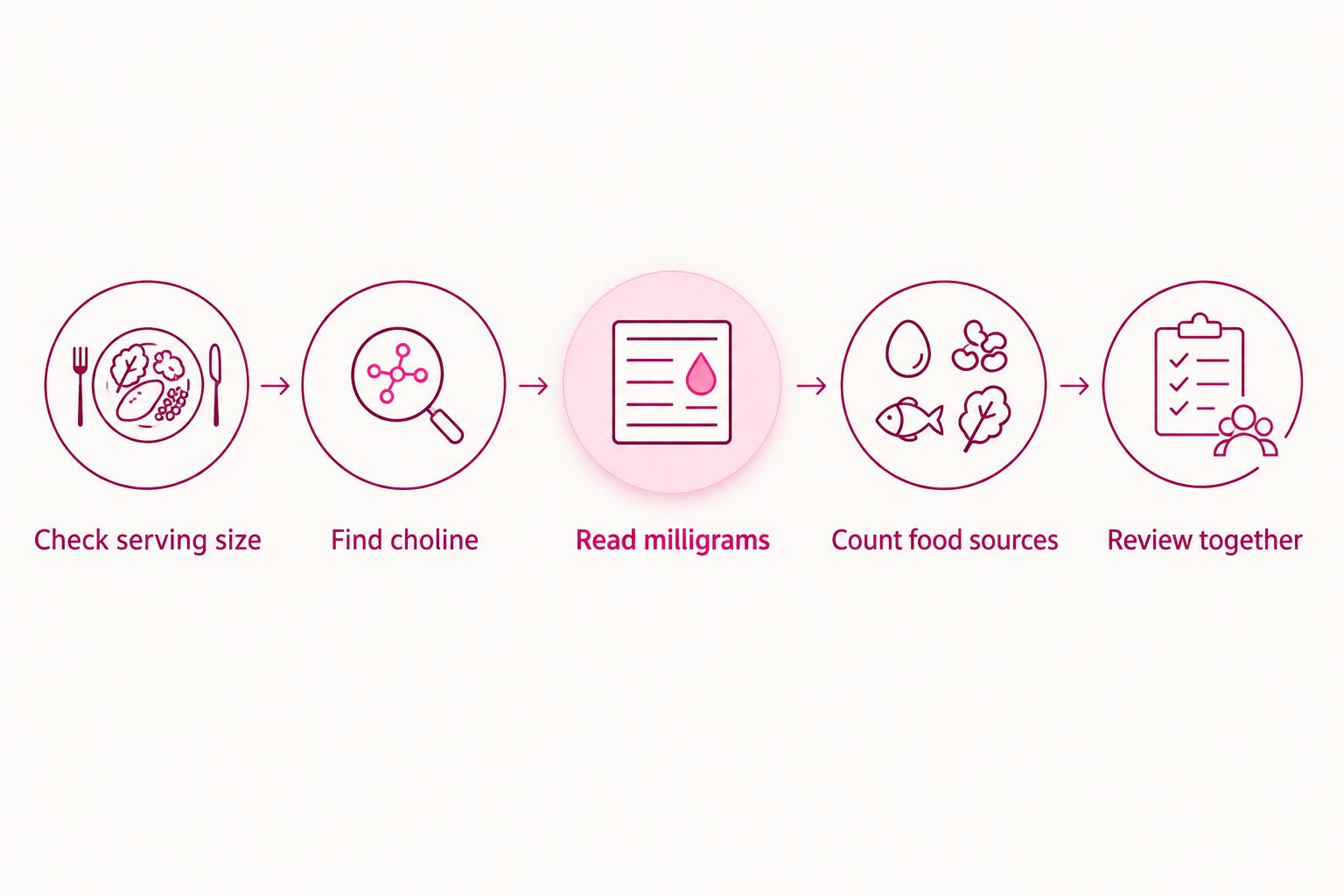
Use this label review when you compare formulas in 2026. Read the amount per serving before you decide whether a separate supplement belongs in your routine.
- Check serving size. Find out how many capsules, gummies, or other units make up the labeled serving. One unit is not necessarily one serving.
- Find choline. Look for a separate choline entry on the Supplement Facts panel. Do not infer its presence from a general prenatal description.
- Read milligrams. Use the declared choline amount, not the weight of an ingredient blend or the compound name alone.
- Count food sources. Include your usual meals and any other supplements with choline.
- Review together. Bring the labels and food notes to your healthcare provider before you add or change a supplement.
Read milligrams before percent Daily Value
The FDA Daily Value for choline used on standard labels for adults and children age four and older is 550 mg. Pregnancy-specific reference information is different, so a percentage without context can confuse the decision.
For this pregnancy question, focus first on the milligrams of choline per serving and the 450 mg daily Adequate Intake. Then ask your provider to interpret the label percentage if its reference basis is unclear.
Separate the nutrient amount from the ingredient name
An ingredient source and its nutrient contribution are not interchangeable. If a label lists a choline compound, use the declared amount of choline on the Supplement Facts panel for your calculation.
If the page description and bottle label leave you unsure, ask the manufacturer for clarification. Do not estimate a choline dose from an ingredient name or a photograph that you cannot read clearly.
A prenatal formula or a separate choline supplement?
A prenatal formula and a separate choline supplement serve different selection needs. The first lets you review several nutrients together. The second requires a focused check of choline alongside your existing routine.
Pink Stork prenatal vitamins suit women who want a doctor-formulated prenatal option. Whether a separate choline product belongs beside that prenatal depends on the current labels and your overall intake, not the brand name alone.
| Option | Best for | Verified product detail | What to check before purchase |
|---|---|---|---|
| Total Prenatal + DHA | Readers who want to review a broad prenatal formula | Its product description states that it delivers 100% Daily Value of 14 OBGYN-recommended nutrients | Check the current panel for the choline amount rather than assume the broader nutrient statement covers it |
| Choline supplement for a provider-reviewed prenatal plan | Readers whose provider recommends a separate choline source | Its product description identifies choline bitartrate from VitaCholine® | Confirm the declared choline per serving and count food and other supplements first |
The practical advantage of a broad prenatal is a single formula to evaluate across several nutrients. Its limitation for this question is that a broad formula description does not establish the choline amount.
A separate choline product offers a focused option to discuss. It also adds another serving and label to track. Neither format removes the need to count your total intake.
Explore your prenatal and choline options

A prenatal formula described as delivering 100% Daily Value of 14 OBGYN-recommended nutrients.
$36

Why your choline plan varies
The pregnancy reference amount is a consistent starting point. The way you reach it depends on what you eat and what your supplements actually contain.
- Food choices: Animal foods and plant foods contribute different amounts of choline. Record your actual meals rather than label your diet as simply adequate or inadequate.
- Portion sizes: A food name without a portion does not establish its nutrient contribution. Include the amount you usually eat when you ask for a dietary assessment.
- Prenatal formulation: Check the specific formula and current label. A shared category name does not mean different products contain the same choline amount.
- Other supplements: Count choline in every product you take. A separate supplement should not disappear from the total just because you take it at a different time.
- Life stage: The NIH reference changes from 450 mg during pregnancy to 550 mg during breastfeeding. Reassess your plan when your circumstances change.
These factors explain why two women can use different supplement routines without either product label telling the whole story. Your provider needs the combined picture to offer individual guidance.
Can food count toward the pregnancy choline target?
The 450 mg pregnancy target includes food. A supplement is one possible contributor, not a replacement for the rest of your diet.
Ask a registered dietitian to assess your usual food sources if you want a clearer estimate, especially when food restrictions or strong aversions limit your choices.
Does every prenatal contain 450 mg of choline?
The 450 mg daily target does not mean every prenatal contains 450 mg. Read the current Supplement Facts panel and count the contribution from food before you decide that you need an additional product.
A list of vitamins, a DHA statement, or a general prenatal claim does not answer the choline question by itself.
Is more choline always better during pregnancy?
The 450 mg Adequate Intake is a target, not a reason to take progressively larger doses. NIH lists a choline upper intake level of 3,500 mg per day for adults, including pregnant adults, and 3,000 mg per day for ages 14 through 18.
Those upper limits are not recommended doses. Excess choline can cause adverse effects, so review any additional supplement with your healthcare provider rather than use the upper limit as a goal.
What should you bring to your prenatal appointment?
Make your 2026 supplement review concrete. Bring photos of each Supplement Facts panel, the directions, and a short description of your usual meals.
Useful questions include:
- How much choline does my current prenatal provide per serving?
- Does my food intake appear to cover the rest of the pregnancy target?
- Would a separate choline supplement fit my overall plan?
- Which parts of my routine should change after delivery?
Ask your provider to write down any recommended supplement amount and serving instructions. That gives you something clear to follow without a mental calculation each time you take your prenatal.
Sources for your 2026 label review
The general nutrition reference values in this guide come from the NIH Office of Dietary Supplements, Choline Fact Sheet for Health Professionals. Its scope includes life-stage Adequate Intakes, food sources, nutrient functions, and upper intake levels. The label discussion also draws on FDA Daily Value guidance.
Product details come from the supplied Pink Stork product descriptions. General choline guidance is not evidence of a particular product's choline amount, and it does not replace individual medical advice.
FAQ
How much choline do I need each day while pregnant?
The NIH Adequate Intake during pregnancy is 450 mg of choline per day from food and supplements combined. It is not an instruction to take a separate 450 mg supplement.
What should I look for in choline prenatal vitamins?
Look for the declared milligrams of choline per serving on the Supplement Facts panel. Check the serving size, count food sources, and review the total with your healthcare provider.
Do I need a separate choline supplement with my prenatal?
A separate choline supplement is an individual decision based on your prenatal label, food intake, and provider guidance. Do not add one solely because the prenatal contains less than the full pregnancy reference amount.
Can I get choline from food during pregnancy?
Yes, food contributes to your daily choline intake. Eggs, meat, fish, dairy foods, soybeans, beans, and some vegetables are sources, with amounts that vary by food and portion.
Does the product name tell me how much choline a prenatal contains?
No, a prenatal product name does not establish its choline amount. Use the current Supplement Facts panel for the declared amount per serving.
How much choline do I need while breastfeeding?
The NIH Adequate Intake while breastfeeding is 550 mg per day from food and supplements combined. Review your prenatal or postnatal routine with your healthcare provider after delivery.
Is the choline upper limit the amount I should aim for?
No, an upper intake level is not a daily target. The pregnancy Adequate Intake is 450 mg per day, and any additional supplement deserves a provider review.
One last thing
A prenatal's nutrient count cannot answer your choline question. Even a formula with a detailed list deserves a separate check for choline, serving size, and the contribution from meals.
You do not need a more complicated routine. You need a clear one. Explore Pink Stork's prenatal and choline options, then choose with your provider based on the current labels and your needs.
Related guides
- How to compare choline prenatal vitamins
- How to check folate overlap across prenatal supplements
- How to choose between liquid prenatal vitamins and capsules
† These statements have not been evaluated by the Food and Drug Administration. This product is not intended to diagnose, treat, cure, or prevent any disease. Always consult your healthcare provider before starting any new supplement, especially during pregnancy, breastfeeding, or while managing a medical condition. Keep out of reach of children.