· By Editorial Team
Liquid prenatal vitamins or capsules: which format fits you?
Liquid prenatal vitamins fit you if you prefer a measured liquid instead of a capsule, while capsules fit you if you prefer a premeasured serving without a liquid taste. Choose by nutrient amounts, label directions, and the format you can take consistently, not by an assumption that liquid works better. Either format still needs to match the prenatal plan you discuss with your healthcare provider.
TL;DR
- Liquid prenatal vitamins fit a pill-free routine; capsules offer a premeasured alternative.
- Pink Stork offers prenatal choices to compare by nutrient amounts, serving directions, and personal preference.
- A liquid format does not establish better absorption or a more complete prenatal formula.
- Check the full label with your healthcare provider before you choose or switch prenatal vitamins.
If you want a starting point for your 2026 comparison, explore Total Prenatal + DHA for your prenatal routine. Its product description states that it delivers 100% Daily Value of 14 OBGYN-recommended nutrients. That is a useful label detail, not a reason to skip a full nutrient comparison.
Always consult your healthcare provider before starting any new supplement, especially during pregnancy, breastfeeding, or while managing a medical condition.
Why this matters
A prenatal vitamin has to fit real life. If you struggle to swallow capsules, a measured liquid deserves a closer look. If flavor or a bottle-and-measure routine feels difficult, capsules deserve equal consideration.
Your preference matters, but it answers only part of the question. The format tells you how you take the supplement, while the Supplement Facts panel tells you what you take. You need both pieces before you choose.
Liquid prenatal vitamins or capsules: which format fits you?
Liquid prenatal vitamins fit readers who want an alternative to capsules and feel comfortable with a measured serving. Capsules fit readers who prefer a premeasured unit and do not struggle with that delivery format. Neither format alone tells you whether a prenatal contains the nutrients and amounts your provider recommends.
Use this comparison to separate convenience from formulation:
| Decision point | Liquid prenatal vitamins | Prenatal capsules |
|---|---|---|
| Best for | People who prefer not to swallow capsules | People who prefer a premeasured format |
| How you take them | Measure the serving according to the label | Take the labeled number of capsules |
| Main convenience | An alternative to a capsule | No liquid measurement |
| Practical tradeoff | Taste and measurement are part of the routine | Capsule size and the number per serving matter |
| What still needs review | Nutrient amounts, ingredients, and directions | Nutrient amounts, ingredients, and directions |
| What the format does not prove | Better absorption or greater completeness | Greater completeness or better tolerance |
Before your 2026 purchase, read the current label rather than rely on an old bottle photo, a review, or a format claim. A liquid and a capsule prenatal are not automatically interchangeable, even when both are intended for pregnancy.
Liquid prenatal vitamins: best for a pill-free routine
A liquid prenatal gives you a different way to take a supplement when capsules do not suit your preferences. You still need to measure the labeled serving accurately. A household spoon is not a substitute for a marked measuring device.
The main advantage is practical: you do not need to swallow a capsule. The tradeoff is also practical: you must account for flavor, measurement, and the storage instructions on that particular bottle.
Check whether the label gives directions to shake, refrigerate, or use the product within a particular period after opening. Follow the instructions that actually appear on your product. Do not assume every liquid prenatal has the same requirements.
If you want to mix a liquid into food or a drink, first check the manufacturer's directions or ask a pharmacist. A serving left in an unfinished drink is not the same as a serving you fully consume.
Prenatal capsules: best for a premeasured routine
Capsules remove the need to measure a liquid. The serving size still matters, because a serving can include more than one capsule. Check the number on the label before you compare nutrient amounts or decide how the product fits your day.
The main advantage is a straightforward, premeasured format. The limitation is that capsule size, texture, or the act of swallowing one can be uncomfortable for some readers.
Do not open a capsule or change how you take it unless the manufacturer or your pharmacist confirms that the change is appropriate for that product. A capsule's appearance does not tell you whether its contents are suitable to mix into food.
Choose capsules because they fit your routine, not because you assume every capsule formula is identical. Ingredients and serving directions still deserve the same attention you would give a liquid.
How to compare prenatal labels before you choose
For your 2026 label check, compare a full daily serving against a full daily serving. Amounts per capsule and amounts per measured liquid serving are not meaningful comparisons until you account for the complete directions.
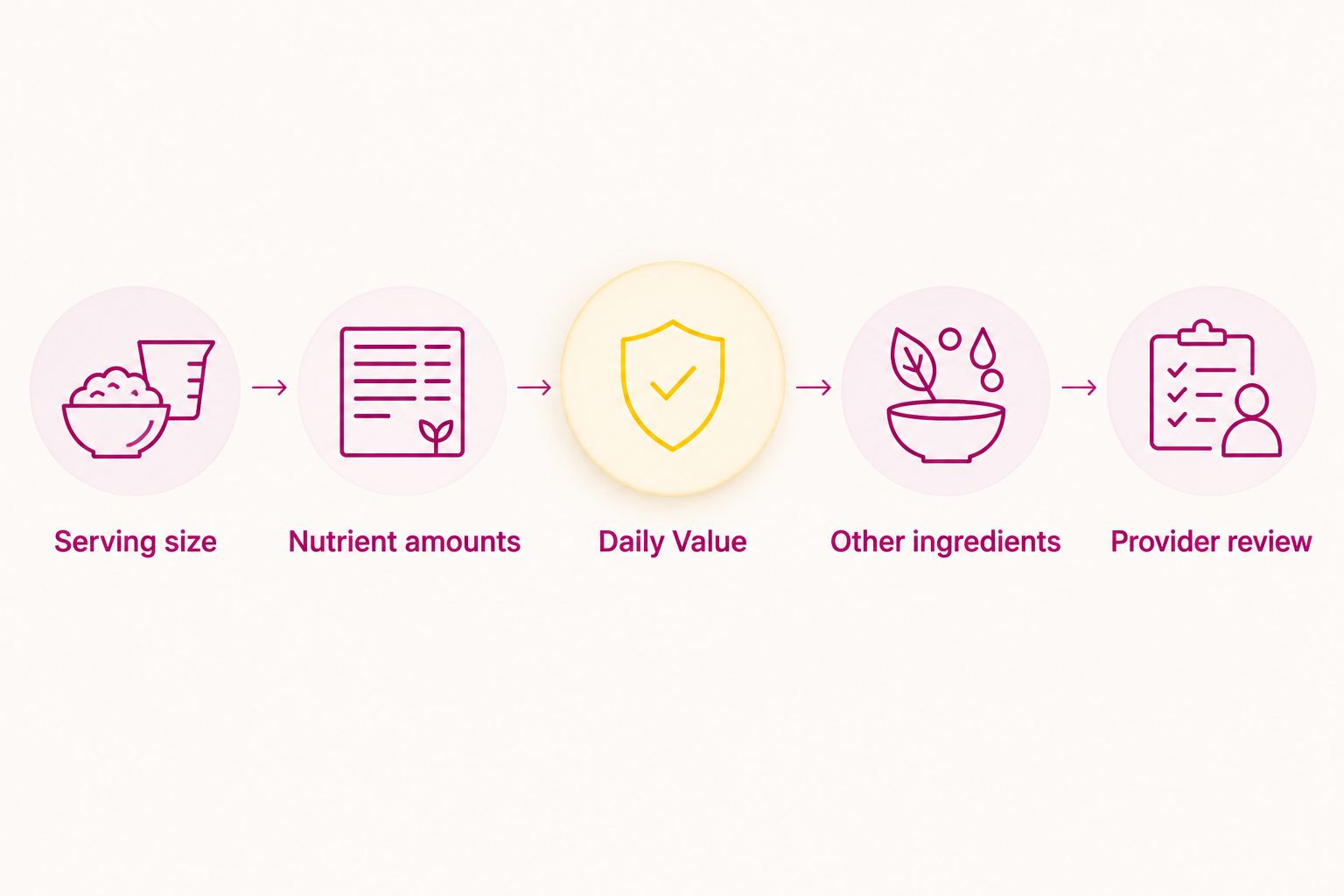
Use this sequence:
- Serving size: Find the labeled daily serving and how you must measure or take it.
- Nutrient amounts: Compare the actual amounts and units, not just the list of nutrient names.
- Daily Value: Read the percentages alongside the amounts rather than treat one percentage as a complete nutrition plan.
- Other ingredients: Review capsule materials, flavors, sweeteners, and any listed allergens relevant to you.
- Provider review: Bring the label and a list of your other supplements and medicines to your healthcare provider.
A product name cannot do this work for you. Words such as prenatal, total, or premium do not replace the Supplement Facts panel, and a liquid texture does not reveal nutrient content.
Put nutrient numbers in context
The National Institutes of Health Office of Dietary Supplements lists a pregnancy recommended dietary allowance of 600 mcg dietary folate equivalents, or DFE, for folate. Its pregnancy recommended dietary allowance for iron is 27 mg per day, and its adequate intake for choline is 450 mg per day. These reference amounts describe total daily intake, not an instruction to obtain the entire amount from a supplement.
For a 2026 prenatal decision, use the NIH Office of Dietary Supplements fact sheets on folate, iron, and choline as general reference material. Your provider can interpret those reference amounts alongside your diet, other supplements, and individual circumstances.
Folate labels deserve particular care because mcg DFE and mcg of folic acid are not interchangeable units. If the panel lists both, ask your provider or pharmacist to explain the amounts before you compare products.
Pink Stork prenatal options: compare the verified details
Pink Stork prenatal vitamins suit readers who want liquid and nonliquid options to compare with their healthcare provider. Start with the product facts, then confirm the current Supplement Facts panel and directions before purchase.
These descriptions identify different formulas, not equivalent servings or a head-to-head effectiveness result:
| Product | Best for | Verified product detail | What to check next |
|---|---|---|---|
| Total Prenatal + DHA | Readers who want to start with a prenatal formula named with DHA | The supplied description states 100% Daily Value of 14 OBGYN-recommended nutrients | Current nutrient amounts, serving format, and directions |
| Liquid Prenatal + Postnatal for a liquid prenatal option | Readers who want to explore a liquid format | The supplied description states 100% of 16 vitamins recommended by OB GYNs | Current nutrient amounts, measured serving, and storage directions |
The difference between 14 nutrients and 16 vitamins is not a completeness score. The descriptions use different terms, and neither count tells you the amount of every nutrient or how the formula fits your diet.
The practical advantage of the liquid option is its delivery format. Its practical limitation is the need to measure a serving. For the other formula, confirm the current serving form and directions rather than infer them from its name.
Explore the prenatal formulas


Why your best prenatal format varies
Your choice can change as your preferences and daily routine change. Use these factors to identify what matters to you, without assume that another person's favorite must be yours:
- Capsule comfort: If capsules are difficult for you, a liquid offers a different delivery format.
- Taste preference: A liquid makes taste part of the experience. Read the current product description rather than assume a flavor.
- Measurement: Liquid servings require accurate measurement. Capsules require attention to the labeled count.
- Daily schedule: Choose a format whose directions fit the routine you can realistically follow.
- Formula fit: Compare nutrient amounts with your provider's recommendations, regardless of format.
- Storage needs: Read the bottle's instructions before you decide where the product will live at home or during travel.
Keep a short note of the issue you want to solve. “I dislike capsules” points toward a format change. “I need to review my iron intake” points toward a label and provider discussion, not a format decision alone.
Do liquid prenatal vitamins absorb better than capsules?
A liquid format alone does not establish better absorption. A claim about one formula needs evidence about that formula, not just an explanation that liquid is already liquid.
For your purchase, focus on verified ingredient forms, amounts, and directions. Do not substitute a general absorption slogan for a nutrient-by-nutrient label check.
Can you switch from capsules to a liquid prenatal?
A switch requires a comparison of the complete daily servings, not a capsule-for-spoonful substitution. Review both labels with your healthcare provider so the change reflects your nutrient plan rather than only your format preference.
For a 2026 switch, use the labels on the products you actually plan to take. Do not combine both daily servings unless your provider specifically directs you to do so.
What if neither format feels comfortable?
You do not need to force a format that is difficult to take. Tell your healthcare provider exactly what gets in the way, such as capsule size, liquid taste, or discomfort after a dose.
Ask about an alternative formulation or a change that follows the product's directions. If you cannot keep fluids or supplements down, contact your healthcare provider rather than repeatedly adjust doses on your own.
FAQ
What's the best reason to choose liquid prenatal vitamins?
Liquid prenatal vitamins fit readers who prefer a measured liquid instead of capsules. Check the complete nutrient label and serving directions before you choose.
Are liquid prenatal vitamins more complete than capsules?
A liquid format does not establish a more complete formula. Compare the nutrients and amounts in each product's full daily serving with your healthcare provider.
Can I mix a liquid prenatal into my breakfast?
Check the product directions or ask a pharmacist before you mix a liquid prenatal into food or a drink. An unfinished portion can leave part of the measured serving behind.
Does 100% Daily Value mean I do not need to review my diet?
No, 100% Daily Value is label information, not a complete assessment of your diet or individual needs. Your provider can review the supplement alongside your food intake and other products.
Should I take liquid prenatal vitamins and capsules together?
Do not combine full daily servings unless your healthcare provider specifically directs you to do so. The two products can contain overlapping nutrients.
Can I open prenatal capsules if they are hard to swallow?
Do not open prenatal capsules unless the manufacturer or your pharmacist confirms that the change is appropriate for that product. Ask about another format if capsules do not fit your needs.
What should I bring to a prenatal vitamin appointment?
Bring the current Supplement Facts panel, serving directions, and a list of your medicines and other supplements. Tell your provider which format you prefer and what has made past supplements difficult to take.
One last thing
Try the routine on paper before you choose the bottle. Decide where you will store it, how you will measure or take the serving, and which label directions need to fit your day. This simple check often makes a format preference clearer than another product review.
You deserve a choice that feels understandable, not overwhelming. Explore Pink Stork's prenatal options, review the current labels with your healthcare provider, and choose the format that fits your nutrient plan and everyday life.
Related guides
- Liquid prenatal vitamins for a pill-free routine
- Choline and prenatal vitamin label choices
- Prenatal vitamins with vitamin D
† These statements have not been evaluated by the Food and Drug Administration. This product is not intended to diagnose, treat, cure, or prevent any disease. Always consult your healthcare provider before starting any new supplement, especially during pregnancy, breastfeeding, or while managing a medical condition. Keep out of reach of children.