· By Editorial Team
Best folate supplements for pregnancy in 2026
Pink Stork Total Prenatal is the first product to explore if you want a prenatal rather than a separate folate supplement for pregnancy in 2026. Start with the Total Prenatal product details, and always consult your healthcare provider before starting any new supplement, especially during pregnancy, breastfeeding, or while managing a medical condition.
TL;DR
- Your folate supplement pregnancy search starts with a choice: a prenatal or an individual folate product.
- Explore Pink Stork Total Prenatal first when you want a prenatal, not an individual nutrient supplement.
- Methylated Folate and Liquid Folate are options to discuss when your provider recommends a separate folate product.
- Compare folate form, serving size, and mcg DFE before you combine supplements.
Why this matters
You want a clear answer, not another list of bottles. The useful question is whether you need a prenatal, a separate folate supplement, or a different format within a plan your healthcare provider recommends.
Folate is vitamin B9. It supports normal cell division and red blood cell formation.† During pregnancy, the recommended intake is higher than it is for adults who are not pregnant. That makes the amount on the label important, but the amount alone does not tell you which product fits your needs.
For your 2026 purchase, separate two decisions: which prenatal fits your overall nutrition plan, and whether an additional folate product belongs in that plan. A separate folate supplement is not an automatic addition to a prenatal. Review both labels before you combine them.
You do not need to make this decision alone. Bring your current supplement list to your prenatal appointment, including vitamins, powders, and individual nutrient products.
What makes a folate supplement a good fit?
A useful comparison starts with the label and your provider's recommendation. These criteria matter more than a broad claim that one product is best for every pregnancy.
- Purpose: Choose between a prenatal product and an individual folate supplement. They serve different roles in your routine.
- Folate form: Read whether the label lists folic acid, methylfolate, or another specified form. Do not treat the names as interchangeable.
- Folate amount: Compare the labeled amount in micrograms of dietary folate equivalents, usually written as mcg DFE.
- Serving size: Check how much product makes one serving before you compare amounts or follow directions.
- Format: Select a format you can measure and use as directed. A liquid still requires attention to its serving instructions.
- Your full routine: Review the combined folate from your prenatal and any separate supplement with your healthcare provider.
The best fit is the product that matches your agreed nutrition plan. A larger number on the label does not, by itself, make a better choice.
Pink Stork prenatal and folate options at a glance
This 2026 comparison organizes products by purpose, not by claims of better pregnancy outcomes. Use it to decide which product page or label to discuss with your provider.
| Product | Best for | Verified product detail | Important boundary |
|---|---|---|---|
| Total Prenatal | Readers who want to explore a prenatal first | A prenatal product in the brand's range | Review its current label before you add separate folate |
| Methylated Folate for an individual folate option | Readers whose provider recommends a separate methylated folate product | The product description states that it provides methylated folate and 100% of the daily value | A daily-value percentage is not a personalized pregnancy recommendation |
| Liquid Folate | Readers whose provider recommends separate folate and who prefer a liquid | The product description identifies methylated folate in a liquid format | Follow its own serving directions, rather than another product's instructions |
None of these use cases replaces a review of your current supplements. A format preference helps narrow your choice, but it does not determine the amount you need.
Total Prenatal: best for a prenatal-first decision
Total Prenatal is the first product to explore when your goal is a prenatal routine rather than a separate nutrient supplement. Start with its current Supplement Facts panel and directions, then review them with your healthcare provider.
A prenatal-first approach keeps the decision focused. Instead of choosing folate on its own and then adding other products around it, you can first review the prenatal you intend to use.
Best for: You want to choose a prenatal and understand whether a separate folate product is necessary.
Reasons to explore Total Prenatal:
- It matches the intent of a prenatal purchase.
- Its label gives you a starting point for a provider conversation about your supplement routine.
- You can compare it with your current prenatal before you make a change.
What to check:
- Read the current folate form, amount, and serving directions on the product label.
- Review any separate folate product before you add it to this prenatal.
Do not assume that the name tells you every nutrient amount. Product names help you find the right category; the Supplement Facts panel helps you make the actual decision.
Verdict: Explore Total Prenatal first if you want a prenatal, then confirm your folate plan with your provider.
Methylated Folate: best for a provider-directed separate supplement
Methylated Folate is an individual folate option. Its product description states that it provides methylated folate and 100% of the daily value.
That description identifies the nutrient and the product's stated daily-value percentage. For your pregnancy plan, still read the current label for the amount, serving size, and directions. A percentage does not replace that information.
Best for: Your healthcare provider recommends a separate methylated folate product within your existing routine.
Reasons to explore Methylated Folate:
- Its purpose is specific to folate.
- Its product description identifies the methylated form.
- You can assess it alongside a prenatal instead of treating it as a replacement.
What to check:
- Confirm how its labeled amount fits with folate already in your prenatal.
- Do not use an individual folate product as a substitute for the rest of your prenatal nutrition plan.
If you already take a prenatal, bring both labels to your provider. Ask whether the separate product has a defined role and what directions you should follow.
Verdict: Choose Methylated Folate only when a separate folate product fits your provider's recommendation.
Liquid Folate: best for a liquid-format preference
Liquid Folate features methylated folate in a liquid format. It is an option to discuss if your healthcare provider recommends separate folate and you prefer a liquid product.
The format is the practical distinction here. It does not establish a different pregnancy requirement or a guaranteed benefit over another form.
Best for: You prefer a liquid and have a provider-directed reason to use individual folate.
Reasons to explore Liquid Folate:
- It offers a liquid-format choice.
- Its product description identifies methylated folate.
- It gives you another format to review within the same separate-supplement decision.
What to check:
- Use the product's specified measure and directions.
- Do not transfer another folate product's serving instructions to the liquid.
Make sure the directions are practical for your daily routine. If a serving instruction is unclear, ask your provider or pharmacist before you use the product.
Verdict: Explore Liquid Folate when both the format and the separate-supplement role fit your plan.
Explore individual folate options


Folate, folic acid, and mcg DFE: what the label means
Folate is the general name for vitamin B9. Folic acid is a form used in supplements and fortified foods. Methylfolate is another form that appears in supplement products.
The names matter because public-health recommendations sometimes refer specifically to folic acid, rather than to every form of folate. If your healthcare provider recommends folic acid, ask before you substitute a methylated folate product.
The NIH Office of Dietary Supplements lists these recommended daily intakes:
- Adults: 400 mcg DFE.
- Pregnancy: 600 mcg DFE.
- Breastfeeding: 500 mcg DFE.
These amounts describe total intake, not an instruction to buy a supplement with that exact amount. Food and supplements both contribute to the overall plan.
DFE means dietary folate equivalents. The unit accounts for differences in how the body uses different sources of folate. A label's mcg DFE figure and its parenthetical folic acid amount are therefore not necessarily the same number.
The CDC recommends 400 mcg of folic acid daily for women capable of pregnancy. That recommendation and the pregnancy intake of 600 mcg DFE use different terms and serve different purposes. Do not read them as instructions to add two supplement amounts together.
Educational references for this 2026 guide are the NIH Office of Dietary Supplements' Folate Fact Sheet for Health Professionals, for intake amounts and DFE terminology, and the CDC's About Folic Acid, for its folic acid recommendation. These are general nutrition references, not endorsements of a specific product.
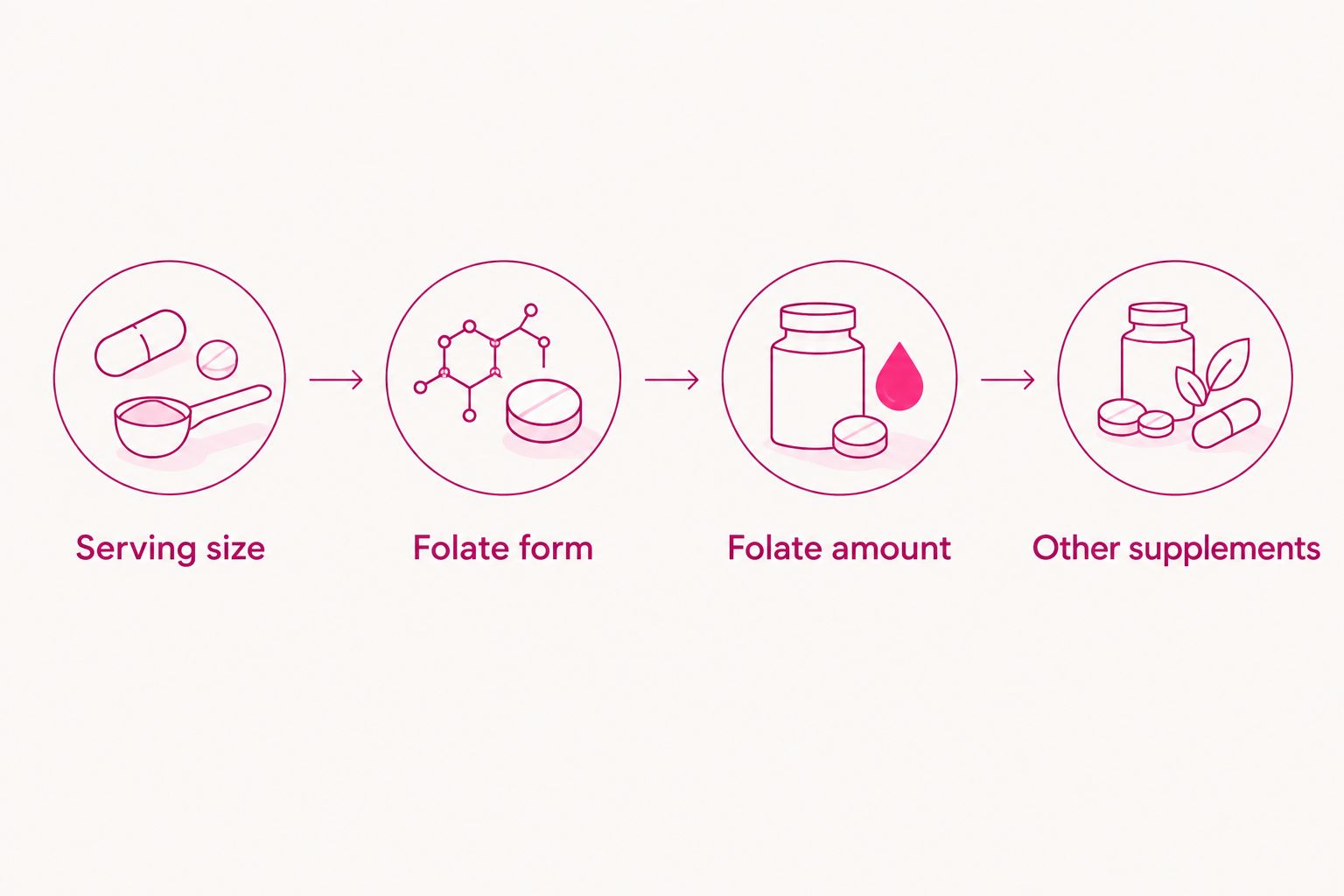
How to review your folate label before purchase
Use this sequence for your 2026 label review. Have the product page or bottle in front of you, along with the labels of any supplements you already take.
Serving size
Find the amount of product that makes one serving. Read the directions separately, because the nutrient panel and the use instructions answer different questions.
Folate form
Write down the exact form named on the label. Keep that wording when you speak with your provider, rather than replacing every form with the general word folate.
Folate amount
Record the mcg DFE figure and any parenthetical amount. If you do not understand how the label presents them, ask your provider or pharmacist to explain the distinction.
Other supplements
List every product in your routine that contains folate. Ask your provider to review the combined amount and confirm which products belong in your plan.
Which option should you choose?
Choose by purpose first, then format. If you want a prenatal, explore Total Prenatal and review its label with your healthcare provider. If your provider recommends individual folate, compare Methylated Folate and Liquid Folate against that recommendation.
This guide's recommendations reflect the products' stated purposes and verified descriptions. They do not rank brands, claim one folate form works best for every pregnancy, or predict individual results.
You can make a confident next move without a universal winner: identify the role you need the product to fill, confirm the label, and choose the format that fits your routine.
FAQ
What's the best folate supplement for pregnancy?
The best fit depends on whether you need a prenatal or a separate folate product. Explore Pink Stork Total Prenatal first for a prenatal purchase, and discuss individual folate with your healthcare provider before you add it.
How much folate do I need during pregnancy?
The NIH Office of Dietary Supplements lists 600 mcg DFE daily as the recommended intake during pregnancy. That is a total-intake recommendation, not an instruction to add that amount as a separate supplement.
Is folate the same as folic acid?
Folate is the general name for vitamin B9, while folic acid is a specific form. Methylfolate is another form found in supplements, so keep the exact label wording when you discuss your product with your provider.
Should I take separate folate with my prenatal?
Do not automatically add separate folate to a prenatal. Ask your healthcare provider to review both labels and confirm whether the additional product belongs in your routine.
What does mcg DFE mean on a prenatal label?
Mcg DFE means micrograms of dietary folate equivalents. This unit accounts for differences among folate sources, so it is not always numerically identical to a parenthetical folic acid amount.
Is Liquid Folate better than Methylated Folate?
A liquid format does not establish that a product is better for every pregnancy. Compare the current labels with your provider's recommendation, then consider which format you prefer.
Can I replace a prenatal with a folate supplement?
An individual folate supplement is not a replacement for your overall prenatal nutrition plan. Review your prenatal and any proposed changes with your healthcare provider.
One last thing
For your 2026 decision, do not stop at the daily-value percentage. Read the actual folate amount, its unit, and the serving directions together.
When you feel ready, explore Pink Stork's Total Prenatal details and bring the label to your provider. You deserve a clear plan and a product choice that fits it, without pressure to add more than you need.
Related guides
† These statements have not been evaluated by the Food and Drug Administration. This product is not intended to diagnose, treat, cure, or prevent any disease. Always consult your healthcare provider before starting any new supplement, especially during pregnancy, breastfeeding, or while managing a medical condition. Keep out of reach of children.