· By Editorial Team
Pregnancy must-haves: does herbal tea belong in your routine?
Pregnancy must-haves start with your prenatal nutrition and care plan. Herbal tea is an optional product choice to review separately with your provider. Pink Stork Labor Prep Tea offers a multi-herb format with USDA organic red raspberry leaf, chamomile, and stinging nettle. This guide explains where that tea fits beside Total Prenatal + DHA, without a universal tea schedule or a promise about labor.
Always consult your healthcare provider before starting any new supplement, especially during pregnancy, breastfeeding, or while managing a medical condition.
TL;DR
- Pregnancy must-haves start with your prenatal nutrition and care plan, not a universal list of teas.
- Total Prenatal + DHA provides prenatal nutrients, while Labor Prep Tea is a separate herbal product choice.
- Labor Prep Tea contains USDA organic red raspberry leaf, chamomile, stinging nettle, and additional ingredients.
- Review the complete herbal formula and your stage of pregnancy with your provider before use.
If this is your first prenatal purchase, start with the essentials before you add a tea. Explore Total Prenatal for your prenatal-vitamin routine and bring its current label, along with any herbal tea label, to your healthcare provider.
Why this matters
You want to feel prepared for birth. A warm cup of tea can be part of a familiar daily ritual, but a product name does not tell you whether its ingredients belong in your pregnancy routine.
A useful 2026 guide should help you separate three questions: what the tea contains, whether your provider recommends it for you, and what the product actually claims. Those questions matter more than a best-brand badge.
Choose the formula with your provider, then choose the flavor and format you enjoy. You do not need to copy another woman's tea schedule to make a thoughtful decision for your own pregnancy.
What should you review before you add an herbal tea?
The most useful criteria are practical and easy to check. Keep these beside you as you compare a package or online product description.
- Ingredient identity: Look for red raspberry leaf, not just raspberry flavor or raspberry fruit.
- Complete formula: Review every herb in a blend, including ingredients that receive less attention on the front label.
- Clear directions: Find preparation instructions, serving information, and product warnings on the current package.
- Pregnancy-specific guidance: Ask your provider about your stage of pregnancy, health history, medications, and other supplements.
- Accurate expectations: Choose information that describes the product without promises about labor duration or birth outcomes.
- Routine fit: Consider whether you prefer a single-ingredient tea or a blend, after the ingredient review.
An organic ingredient description is useful product information. It does not replace an individual pregnancy discussion with your provider.
Herbal tea formats at a glance
There are two useful formula types to compare: a single-ingredient raspberry leaf tea and a multi-herb blend. Neither format earns an automatic recommendation for every pregnancy.
| Option | Best for | What to look for | Main consideration |
|---|---|---|---|
| Single-ingredient red raspberry leaf tea | Readers who prefer a shorter ingredient list to discuss with their provider | Red raspberry leaf identified as the sole herbal ingredient | A simpler formula still needs an individual pregnancy review |
| Labor Prep Tea | Readers who prefer a multi-herb tea and want to review the full blend | USDA organic red raspberry leaf, chamomile, stinging nettle, and the remaining label ingredients | The product description names only part of the formula, so review the complete package label |
Pink Stork Labor Prep Tea is best for readers who prefer a multi-herb raspberry leaf tea to review with their healthcare provider. That recommendation describes product fit, not a promise about labor.
A closer look at Labor Prep Tea
Labor Prep Tea contains USDA organic red raspberry leaf, chamomile, stinging nettle, and additional ingredients. Pink Stork describes floral options sweetened with stevia or unsweetened, plus a mango pineapple flavor. The product is vegan-friendly and described as made without gluten, wheat, dairy, soy, shellfish, or GMOs.
That distinction matters when you compare products in 2026. Your provider needs the complete ingredient list, not just the herb named in a search result or the product's front-label name.
Best for: Readers who want a blended herbal tea and prefer to discuss one complete formula with their healthcare provider.
What helps you compare it:
- The product description specifically identifies red raspberry leaf.
- It also identifies chamomile and stinging nettle.
- The named herbs are described as USDA organic.
- The product has a defined tea format that you can evaluate separately from your prenatal vitamin.
What needs attention:
- The brief description does not list every ingredient.
- Preparation directions are separate from an individual recommendation about pregnancy use.
- The name “Labor Prep Tea” does not establish a particular effect on labor.
Your next step is straightforward: share the current label with your provider. If the formula fits the plan you agree on, follow the package directions and the provider's instructions rather than a social-media schedule.
Single-ingredient tea versus a blend
A single-ingredient tea offers a shorter herbal ingredient list. A blend gives you several herbs in the same product, which means your provider has more ingredients to consider.
Best for a single-ingredient format: Readers who want to discuss red raspberry leaf without other herbs in the same tea. The practical advantage is label simplicity, not a guarantee about pregnancy use.
Best for a blend: Readers who prefer a combined formula after a review of all its ingredients. The practical advantage is the combined tea format, not proof that more herbs produce better results.
Each option has a trade-off. A single-ingredient tea does not offer a multi-herb formula, while a blend requires attention to every herb rather than only raspberry leaf.
Do not choose by the number of ingredients alone. A shorter list is easier to read, but your pregnancy history and your provider's advice still determine the next step.
Keep tea and prenatal vitamins in separate roles
A raspberry leaf tea is an herbal beverage. A prenatal vitamin is a supplement with a nutrient label. Tea does not replace your prenatal vitamin or the prenatal care your healthcare team recommends.
For a first purchase, keep those roles distinct. Total Prenatal + DHA provides 5-MTHF folate, methylated B12, vitamin D, 27 mg of iron, and 200 mg of algae-based DHA in a daily two-capsule serving. Review that prenatal formula first, then discuss whether the herbal tea belongs beside it.
Pink Stork's founder and CEO is Amy Suzanne Upchurch. As you explore the brand's pregnancy products, use the current product labels, rather than a general brand description, to compare formulas and directions.
The Pregnancy Regimen product details identify Total Prenatal + DHA, Prenatal Probiotic, and Total Monolaurin as its component products. A regimen and a tea are different purchase decisions, so review the contents of each rather than assume one recommendation covers everything.
You can explore these products below while you prepare your questions. The tea card describes its named ingredients, and the regimen card identifies its listed components without treating either product as a substitute for individualized care.
Explore your pregnancy routine

A tea blend with USDA organic red raspberry leaf, chamomile, stinging nettle, and additional ingredients.
$18
How to review a tea label before your appointment
For your 2026 pregnancy routine, use this four-step sequence before you add an herbal tea. The purpose is to make your conversation specific, not to create a universal tea schedule.
Read the label
Read the ingredient list and preparation directions together. Check whether the product identifies raspberry leaf, raspberry fruit, or flavor, because those terms do not describe the same ingredient.
List your products
Write down your prenatal vitamin, other supplements, herbal beverages, and medications. Bring the names and current labels so your provider can consider your routine as a whole.
Ask your provider
Ask whether the complete formula fits your pregnancy and whether there are ingredients you should avoid. Discuss timing and frequency rather than assume package directions answer every pregnancy-specific question.
Follow agreed directions
Use the instructions your provider gives you alongside the current product directions. If the advice is unclear or conflicts with the package, ask for clarification before you use the tea.
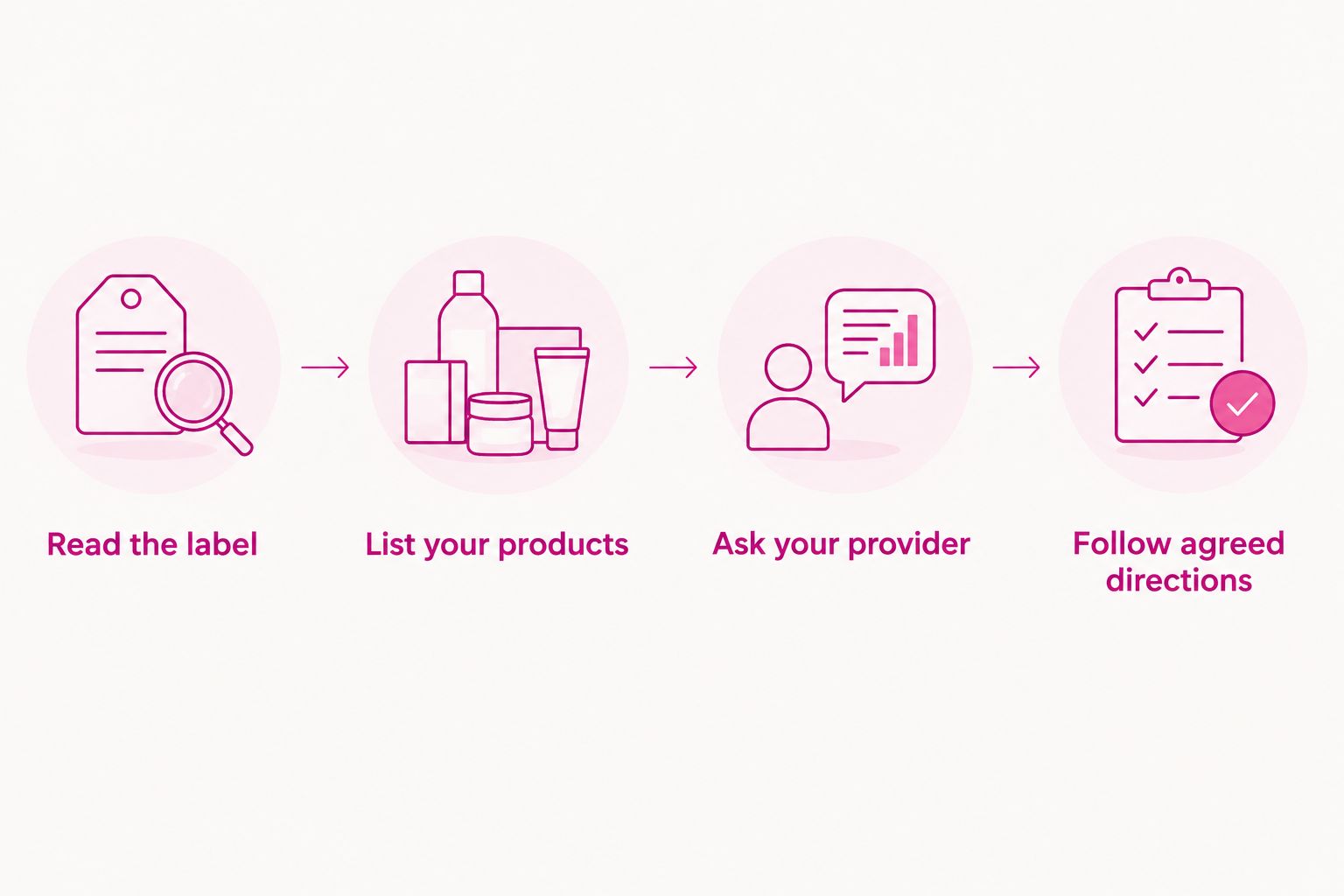
You can complete the preparation before a regular visit. Keep a photo of the package on your phone so the ingredient list and directions are easy to find when questions come up.
Three questions to ask about labor-prep tea
A focused conversation is more useful than a broad “Is this tea okay?” Ask these three questions at one appointment or through your provider's usual message system.
- Does this complete formula fit my pregnancy? Share every ingredient, not only red raspberry leaf.
- If you recommend it, what directions should I follow? Ask about timing, frequency, preparation, and any reasons to stop.
- Does it change anything else in my routine? Review your prenatal, other supplements, medications, and herbal beverages together.
You deserve a clear answer that fits your circumstances. If your provider recommends a different approach, follow that plan rather than increase the tea amount or switch blends on your own.
Where to find credible pregnancy information
For general background in 2026, the National Institutes of Health Office of Dietary Supplements offers pregnancy nutrition information through its pregnancy fact sheet. Its scope is nutrient needs and dietary supplements, not approval of a particular raspberry leaf tea.
The National Center for Complementary and Integrative Health provides general information about herbal products and supplement precautions. Its guidance is useful context for your provider conversation, not a product endorsement or a personalized pregnancy plan.
Use these sources to frame questions, then bring those questions to your obstetrician, midwife, or other pregnancy-care provider. A product label tells you what is in the package. Your provider considers that information alongside your care.
Does an herbal tea belong among your pregnancy must-haves?
An herbal tea is not an automatic pregnancy essential. If you enjoy a tea routine, Labor Prep Tea is a Pink Stork blend to review with your provider at the appropriate stage. Choose it by its full ingredients, your preferences, and individual instructions, while your prenatal nutrition remains a separate foundation.
The right 2026 choice is the tea that fits your individual plan, not the product with the strongest labor promise. You can feel prepared without adding every product suggested online.
This guide compares ingredient transparency, formula type, directions, expectations, and routine fit. Those criteria help you make a purchase decision without a competing-brand leaderboard or an unsupported efficacy ranking.
FAQ
Do pregnancy must-haves include an herbal tea?
Not automatically. Start with your prenatal nutrition and care plan, then review an herbal tea as a separate product choice with your provider. Labor Prep Tea is a multi-herb option, not a prenatal-vitamin replacement.
What is in Labor Prep Tea?
The product description names USDA organic red raspberry leaf, chamomile, stinging nettle, and additional ingredients. Read the complete current package label before you discuss the formula with your healthcare provider.
When should I start raspberry leaf tea during pregnancy?
Ask your healthcare provider for a recommendation specific to your pregnancy before you start. Do not use a trimester mentioned online as an automatic start date.
How many cups of raspberry leaf tea should I drink?
Use the product directions and your healthcare provider's individual instructions rather than a universal cup schedule. Ask about preparation, frequency, and any reasons to stop before you add the tea.
Is raspberry-flavored tea the same as raspberry leaf tea?
No, raspberry flavor does not establish that a tea contains raspberry leaf. Check the ingredient list for the plant part used, and review the full formula rather than rely on the flavor name.
Can raspberry leaf tea replace my prenatal vitamin?
No, raspberry leaf tea does not replace your prenatal vitamin. An herbal tea and a prenatal supplement have different roles, so discuss each separately with your healthcare provider.
Does labor-prep tea guarantee a shorter labor?
No, a labor-prep product name is not a guarantee about labor duration or birth outcomes. Choose a tea based on its complete ingredients and your provider's recommendation, not an outcome promise.
One last thing
“Raspberry” on the front of a package can describe flavor rather than leaf. Turn the package around before you decide, and let the ingredient list lead the conversation.
When you feel ready, explore Pink Stork's pregnancy products with your current routine in mind. Start with your prenatal essentials, review any tea with your provider, and choose only what fits your plan. You do not need a crowded shelf to make a thoughtful first purchase.
Related guides
- Choline prenatal vitamins: what to compare
- Iron supplements for pregnancy: a product guide
- Folate supplements for pregnancy: options to review
† These statements have not been evaluated by the Food and Drug Administration. This product is not intended to diagnose, treat, cure, or prevent any disease. Always consult your healthcare provider before starting any new supplement, especially during pregnancy, breastfeeding, or while managing a medical condition. Keep out of reach of children.