· By Editorial Team
Magnesium for pregnancy: understand Pink Stork's formula
The best magnesium for pregnancy is the complete formula and amount that fits your healthcare provider's plan. Pink Stork Magnesium Glycinate combines buffered magnesium glycinate with vitamin D3 from vegan lichen. This 2026 guide explains those ingredients and how to review the product alongside Total Prenatal + DHA.
Always consult your healthcare provider before starting any new supplement, especially during pregnancy, breastfeeding, or while managing a medical condition.
TL;DR
- Pink Stork Magnesium Glycinate contains buffered magnesium glycinate and vitamin D3 from vegan lichen.
- Review the full formula and elemental magnesium amount with your provider before use during pregnancy.
- Total Prenatal + DHA contains magnesium, so compare both labels before an addition.
- Pregnancy magnesium requirements include food, while the supplemental upper limit covers supplements and medicines.
Start with your prenatal routine. If you use or are considering Total Prenatal as your prenatal vitamin, bring its current Supplement Facts panel to the same appointment as the magnesium label. A separate magnesium product belongs in that conversation, not in a separate decision.
Why this matters
Pregnancy can make a simple supplement choice feel complicated. You want to understand the form, the amount, and whether another bottle belongs beside your prenatal. Those are reasonable questions, and you deserve clear answers.
Magnesium contributes to normal muscle and nerve function and energy production.† That established nutrient role does not mean every pregnant woman needs a separate magnesium supplement, or that every magnesium formula fits pregnancy.
Choose the complete formula, not just the word magnesium on the front label. A product's name helps you identify an option, but the Supplement Facts panel, other ingredients, and your health history determine the discussion with your provider.
For your 2026 purchase decision, separate two questions: how much magnesium your body needs overall, and whether a supplement should contribute to that amount. The answers are related, but they are not interchangeable.
What makes a suitable pregnancy magnesium supplement?
Use these criteria before you compare products. They turn a broad search into a practical label review.
- Elemental magnesium: Find the amount listed as magnesium in the Supplement Facts panel. That is the amount to compare across supplements.
- Magnesium form: Identify the named form, such as glycinate, rather than assume all magnesium products have the same composition.
- Complete ingredient list: Review every active ingredient, plus the other ingredients. A magnesium blend requires review of more than magnesium alone.
- Serving size: Check how many capsules or other units make one serving. The amount per serving is not necessarily the amount per capsule.
- Your existing routine: Include your prenatal, other supplements, medicines, and any magnesium-containing antacids or laxatives in the discussion.
- Provider-directed use: Agree on the purpose, amount, and instructions before you add a supplement during pregnancy.
A clear label helps you ask better questions. It does not replace individual advice, especially if your provider has already given you a specific prenatal plan.
Magnesium options at a glance
These Pink Stork products are options for a label-based conversation in 2026, not a pregnancy approval list. Neither product name establishes the amount you should take.
| Option | Best for | What the name identifies | What to review before purchase |
|---|---|---|---|
| Magnesium Glycinate for a provider-directed magnesium routine | Readers whose provider recommends the glycinate form | A magnesium product named for glycinate | Elemental magnesium, serving size, complete ingredients, and prenatal overlap |
| Magnesium Complex for a complete formula review | Readers whose provider wants to assess the complex formula | A product identified as Magnesium Complex | Exact magnesium forms, elemental amount, and all additional ingredients |
| Magnesium-containing foods | Readers who want to review dietary intake first | Food sources such as beans, nuts, seeds, and whole grains | Your usual portions, food preferences, and provider's nutrition advice |
The table compares decision paths, not treatment outcomes. Food and supplements also serve different roles: food contributes to your overall diet, while a supplement adds a measured amount according to its label.
1. Magnesium Glycinate: a named form to discuss with your provider
Pink Stork Magnesium Glycinate contains buffered magnesium glycinate and vitamin D3 sourced from vegan lichen. Its description identifies a vegan-friendly formula made without gluten, wheat, dairy, soy, or GMOs. Those specific details help your provider assess the exact product rather than magnesium as a broad category.
Magnesium glycinate refers to magnesium bound to glycine, an amino acid. The form name is not the same as the amount of elemental magnesium, so read both the ingredient information and the nutrient amount before you decide.
Magnesium Glycinate advantages:
- Buffered magnesium glycinate is the named magnesium ingredient.
- Added vitamin D3 comes from vegan lichen.
- The vegan-friendly formula is described as made without gluten, wheat, dairy, soy, or GMOs.
Magnesium Glycinate considerations:
- The form name alone does not tell you the appropriate pregnancy dose.
- Oral magnesium supplements can cause diarrhea, nausea, or abdominal discomfort.
- Your provider needs to consider medicines and your health history before you add it.
Best for: A reader whose provider has recommended magnesium glycinate and wants to review this specific product.
Next step: Choose this option only after your provider confirms that its current formula and serving instructions fit your routine. Do not infer a dose from another person's experience.
2. Magnesium Complex: review the entire formula
Magnesium Complex is another product to bring to your provider for consideration. The word complex is a product name, not a substitute for a detailed ingredient review.
Check the current label for the exact magnesium forms, the elemental amount, and any other active ingredients. Compare those details with the recommendation your provider has given you, rather than assume a complex is automatically a better choice.
Magnesium Complex advantages:
- It offers another specific product for your provider to assess.
- Its label gives you a basis for a formula-by-formula comparison.
- You can evaluate it against the same criteria as a named-form product.
Magnesium Complex considerations:
- The product name does not establish its precise composition or pregnancy suitability.
- The complete formula needs review, not just the magnesium amount.
- Oral magnesium supplement tolerability still matters, regardless of the product name.
Best for: A reader whose provider wants to assess this exact formula before a purchase.
Next step: Match the label to your provider's recommendation. If your provider specifies a particular form, do not substitute a different formula based on its name alone.
The product cards below provide a convenient way to examine these two options. Keep the current label and your provider's guidance at the center of your decision.
Magnesium options to review


How much magnesium do pregnant women need?
The National Institutes of Health Office of Dietary Supplements lists pregnancy magnesium recommendations by age in its Magnesium Fact Sheet for Health Professionals. These amounts describe total daily intake from food, beverages, and supplements, not a separate supplement prescription.
| Age during pregnancy | Recommended total daily magnesium |
|---|---|
| 14 to 18 years | 400 mg per day |
| 19 to 30 years | 350 mg per day |
| 31 to 50 years | 360 mg per day |
For a 2026 label comparison, keep these total-intake recommendations separate from the supplemental upper limit. The NIH lists an upper limit of 350 mg per day from supplements and medicines for these age groups. Magnesium naturally present in food does not count toward that supplemental limit.
A total-intake recommendation and a supplemental upper limit answer different questions. You should not turn the total-intake recommendation into the amount to take from a bottle, or subtract an informal food estimate and prescribe the remainder yourself.
These reference amounts also do not establish the dose of either product above. Your provider can account for your diet, prenatal, other products, and individual circumstances before you add supplemental magnesium.
Food belongs in the magnesium conversation
Beans, lentils, nuts, seeds, whole grains, and leafy green vegetables are established dietary magnesium sources. Include the foods you actually eat when you discuss your routine, rather than create an idealized meal plan for the appointment.
Food advantages: These choices contribute magnesium as part of meals and snacks, alongside other nutrients. They also give your provider a clearer picture of your overall intake.
Food considerations: Your intake depends on the foods and portions you choose. A list of magnesium-rich foods does not establish whether you need a supplement.
Best for: Every reader who wants a complete nutrition conversation before an additional purchase.
You do not need a perfect diet to ask for guidance. A brief description of your usual breakfast, lunch, dinner, and snacks is a practical place to start.
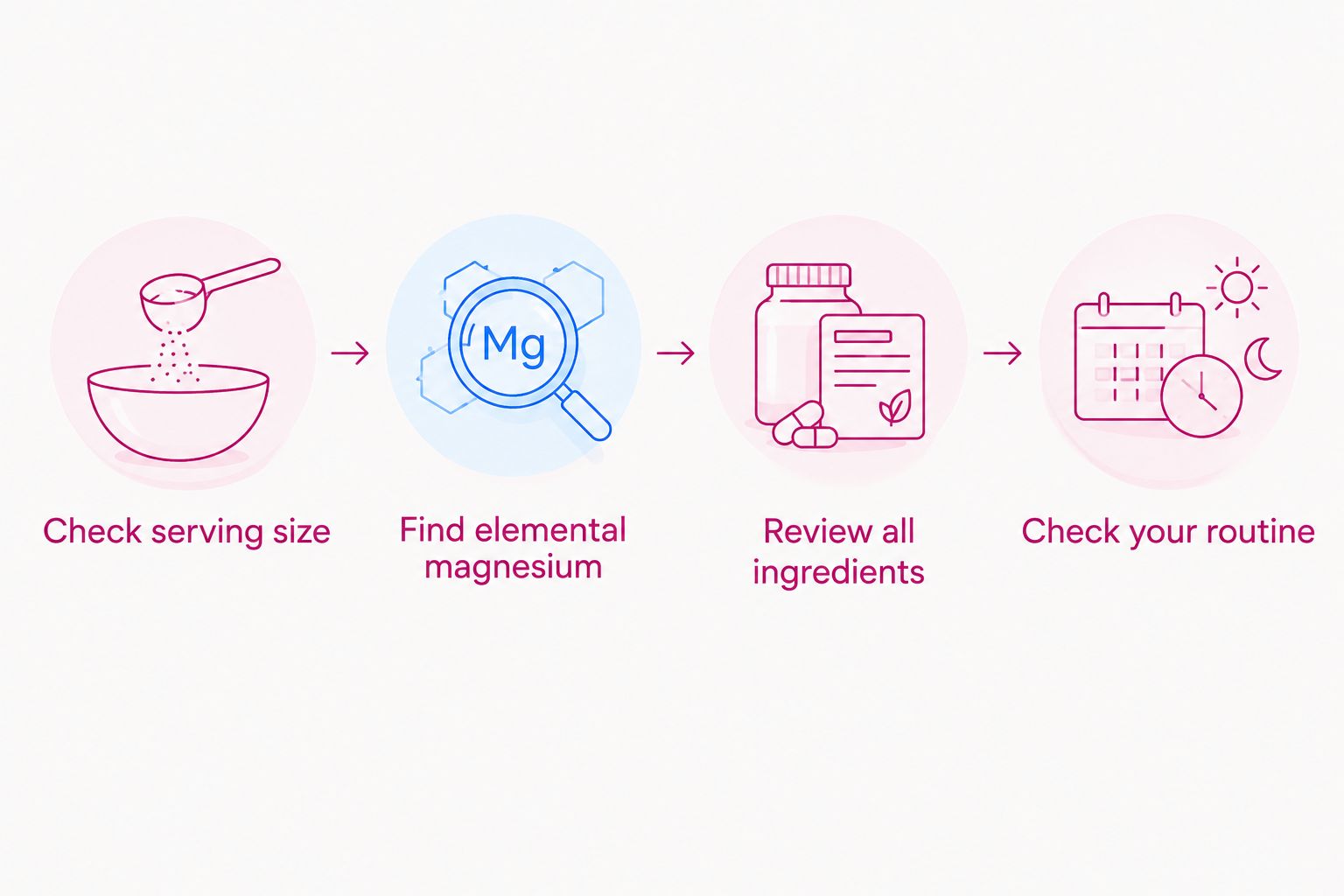
Read the label in this order
Use this sequence for your 2026 supplement review. It keeps the dose discussion separate from product names and front-label descriptions.
Check serving size
Find the number of capsules, tablets, or other units in one serving. Then read the magnesium amount for that full serving. Do not assume the amount shown applies to a single capsule.
Find elemental magnesium
Use the amount listed on the magnesium line of Supplement Facts. A compound's weight and its elemental magnesium content are different measurements, so do not treat a large compound number elsewhere on a label as the nutrient dose.
Review all ingredients
Read the active ingredients and the other ingredients. If a product combines magnesium with herbs or additional compounds, your provider needs to evaluate each one for pregnancy, not just the magnesium portion.
Check your routine
Gather your prenatal label, other supplement labels, and medicine list. Ask your provider which products belong together and whether any need separate timing.
Keep a photo of each label on your phone for the appointment. Include the directions and warnings as well as Supplement Facts, so your provider has the information needed for a specific recommendation.
What to discuss before you start
Tell your provider why you want to add magnesium. If a new symptom prompted your search, describe the symptom rather than assume a supplement is the answer.
The NIH magnesium fact sheet notes interactions with certain antibiotics and bisphosphonates. Kidney disease also requires particular caution with supplemental magnesium because the kidneys play a central role in magnesium excretion. Your provider or pharmacist should review these concerns and any necessary timing instructions.
Ask these practical questions:
- Does a separate magnesium supplement belong in my current prenatal routine?
- Which form and elemental amount do you recommend?
- Does this complete formula fit pregnancy and my medical history?
- Should I separate it from any medicine or other supplement?
- What should I do if I notice digestive discomfort?
Do not take a second serving to compensate for uncertainty. Follow the agreed instructions, and ask your provider or pharmacist about missed doses rather than improvise.
Which option should you choose?
Explore Pink Stork Magnesium Glycinate if its buffered magnesium glycinate and vegan vitamin D3 formula matches your provider's recommendation. Review Magnesium Complex by its own current label rather than assume the formulations are the same.
If you have not had that conversation, your next step is a label review, not a larger supplement routine. Keep Total Prenatal in the discussion so the decision reflects your whole prenatal plan.
For your 2026 purchase, the most useful comparison is straightforward: the recommended form, the elemental amount, the full ingredient list, and the instructions you can follow consistently. You do not need to rank brands to make an informed choice.
FAQ
What's the best magnesium supplement for pregnancy?
The best choice is the complete formula and elemental amount your healthcare provider recommends for you. Pink Stork Magnesium Glycinate is an option to discuss when your provider recommends the glycinate form.
Can I take magnesium with my prenatal vitamin?
Ask your healthcare provider to review both labels before you combine them. The decision should account for your prenatal, other supplements, medicines, and total supplemental magnesium.
How much magnesium do pregnant women need each day?
NIH lists total daily pregnancy recommendations of 400 mg at ages 14 to 18, 350 mg at ages 19 to 30, and 360 mg at ages 31 to 50. These totals include food, beverages, and supplements, and are not stand-alone supplement doses.
Is the 350 mg upper limit the same as my daily magnesium requirement?
No. The 350 mg daily upper limit applies to magnesium from supplements and medicines for these age groups, while pregnancy requirements refer to total intake, including food.
What does elemental magnesium mean on a label?
Elemental magnesium is the amount of magnesium itself, rather than the weight of the entire magnesium compound. Use the magnesium amount in Supplement Facts and check the serving size before you compare products.
Is Magnesium Complex better than Magnesium Glycinate during pregnancy?
Neither product name establishes a better pregnancy choice. Your provider should compare the current formulas, elemental amounts, other ingredients, and your individual needs.
Can magnesium supplements cause digestive discomfort?
Oral magnesium supplements can cause diarrhea, nausea, or abdominal discomfort. Contact your healthcare provider about symptoms and dose instructions rather than change the amount on your own.
Do I need a separate magnesium supplement if I already eat magnesium-rich foods?
A separate supplement is not automatically necessary. Review your usual diet and prenatal routine with your healthcare provider before you add one.
One last thing
The percentage Daily Value on a supplement label is not a personalized pregnancy prescription. Your age-specific recommendation, food intake, and complete routine still matter.
You deserve a clear plan, not another decision to carry alone. Explore the Pink Stork magnesium options above with your provider's advice in hand, and choose the product that fits the recommendation you receive.
Related guides
† These statements have not been evaluated by the Food and Drug Administration. This product is not intended to diagnose, treat, cure, or prevent any disease. Always consult your healthcare provider before starting any new supplement, especially during pregnancy, breastfeeding, or while managing a medical condition. Keep out of reach of children.