· By Editorial Team
Myo-inositol supplements before pregnancy: what to compare
For women before pregnancy, a myo inositol supplement is a source of inositol intended to support normal body functions as part of an individual preconception plan.† Compare the named forms, their amounts per serving, and the full ingredient list with your healthcare provider, while keeping your prenatal vitamin decision separate.
TL;DR
- Compare a myo inositol supplement by ingredient amounts, not the ratio alone.
- Pink Stork offers two myo-inositol and D-chiro-inositol ratios to compare with your healthcare provider.
- A prenatal vitamin and an inositol supplement have different roles in your preconception plan.
- Choose one inositol formula with your provider, rather than combine ratios on your own.
Always consult your healthcare provider before starting any new supplement, especially during pregnancy, breastfeeding, or while managing a medical condition.
Start your prenatal comparison with Total Prenatal for your preconception plan. An inositol product belongs in a separate conversation about whether an additional supplement fits your needs, not as a substitute for a prenatal.
Why inositol comparisons matter before pregnancy
Before pregnancy, you want a supplement choice that makes sense now and clear instructions for what to do after a positive pregnancy test. A label can tell you what a product contains. Your healthcare provider can help decide whether those ingredients belong in your plan.
Inositol labels often emphasize a ratio. That detail matters, but a ratio describes the relationship between ingredients, not the full amount you receive. You still need the Supplement Facts panel and directions to compare products accurately.
For your 2026 preconception plan, keep three decisions distinct: your prenatal vitamin, any additional supplement, and your provider's instructions. You do not need to build a large supplement routine to make a thoughtful choice.
How to compare a myo inositol supplement before pregnancy
1. Define the question you want the supplement to answer
Start with a short note on your phone or a sheet of paper. Write down why you are interested in inositol and what you want to ask your provider. You do not need a paid tracker or a complicated record.
Be specific about your goal without assigning yourself a diagnosis. For example, you can ask whether inositol belongs in your preconception plan and which formulation your provider recommends. That is more useful than a general request for the strongest supplement.
Give your note a 2026 date so you can distinguish current advice from older instructions. Include your current medicines and supplements, even those you take only occasionally. Your provider needs the whole list, not just the product you hope to add.
- State your reason for interest in plain language.
- List your current prenatal and other supplements.
- Include prescription and nonprescription medicines.
- Write down any previous supplement reactions.
- Ask what would make an inositol supplement appropriate for you.
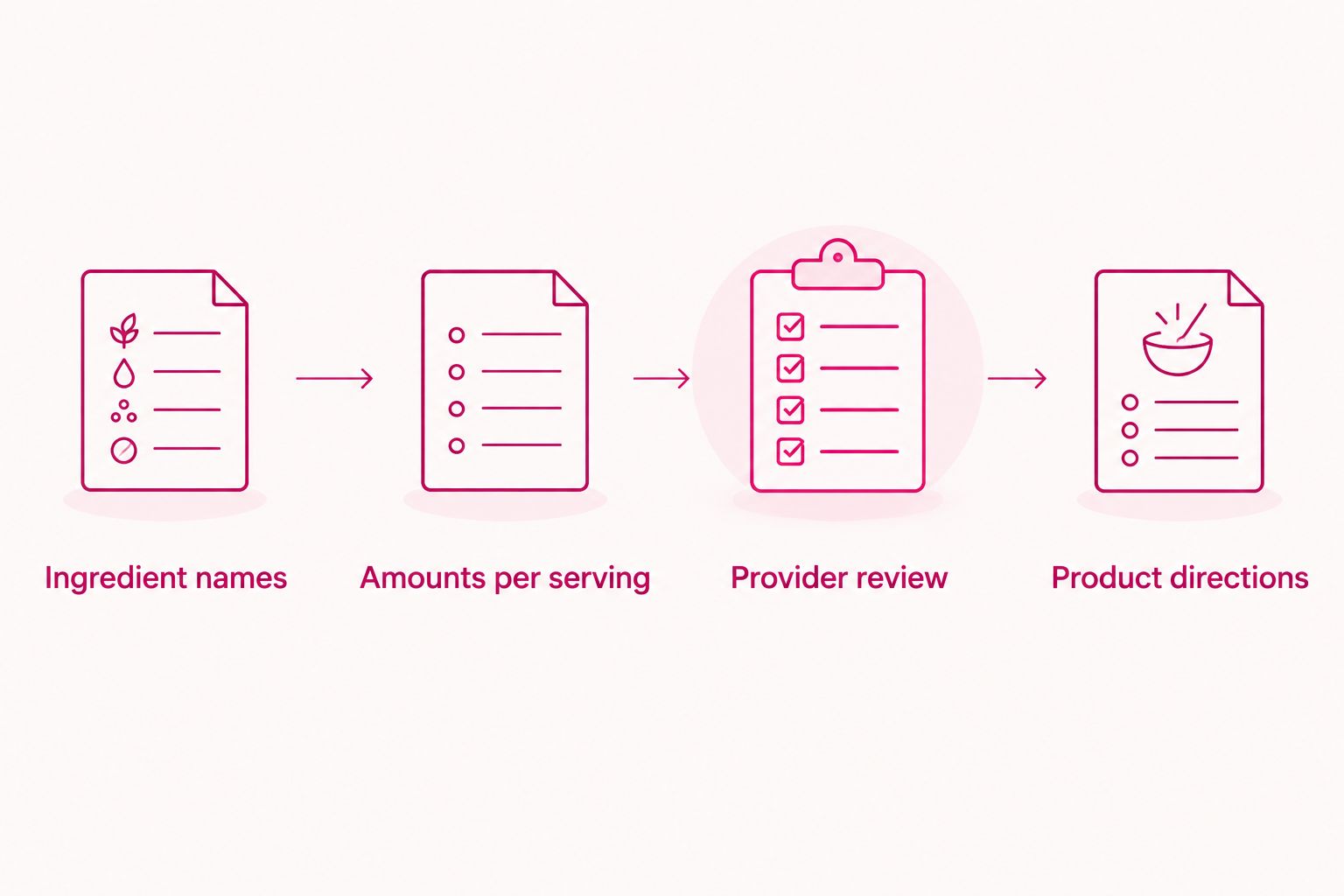
2. Read the ingredient names before the front-label claims
Myo-inositol and D-chiro-inositol are different forms of inositol. A product can name one form or combine them. Read those names first, then check the amount of each ingredient per serving.
The U.S. Food and Drug Administration's dietary supplement labeling guidance identifies the Supplement Facts panel as the place to find serving size and declared dietary ingredients. Use that panel for your comparison rather than a front-label phrase alone.
Keep the units exactly as printed. Milligrams and grams are different units, and an amount per capsule is not necessarily an amount per serving. If the label does not make a detail clear, ask before you choose.
- Find the Supplement Facts panel.
- Identify each form of inositol by name.
- Copy the amount and unit for each form.
- Note whether amounts apply to a serving or an individual capsule.
- Read the other ingredients and allergen information.
3. Compare the two ratios without assuming one is better
Pink Stork myo inositol supplements include the 40:1 myo-inositol and D-chiro-inositol option and the 3.6:1 myo-inositol and D-chiro-inositol option. Both combine the two named forms of inositol, but their ratios differ.
A 40:1 ratio expresses 40 parts myo-inositol to 1 part D-chiro-inositol. A 3.6:1 ratio expresses 3.6 parts myo-inositol to 1 part D-chiro-inositol. Neither ratio, by itself, tells you the total serving amount.
Both formulas are described as products that support hormone health, ovarian function, metabolism, and menstrual cycles.† Those descriptions do not establish which ratio fits your individual preconception plan. Your provider should make that distinction with you.
Pink Stork myo inositol supplements are best for women who want to compare two combined-inositol ratios with their healthcare provider. For a 2026 purchase, use the current product label rather than an old screenshot or someone else's directions.
- Compare both named forms, not just the larger number.
- Record the amount of each form per serving.
- Keep the ratio and total amount in separate columns.
- Ask your provider which ratio fits your plan.
- Choose one formula rather than combine both on your own.
4. Keep your prenatal vitamin decision separate
A prenatal vitamin and an inositol supplement answer different product-selection questions. Do not assume an inositol formula provides the nutrients listed on your prenatal label, or that a prenatal contains inositol. Check each product directly.
Bring both labels to the same appointment. This lets your provider review the complete plan and identify any repeated ingredients. The National Institutes of Health Office of Dietary Supplements advises people to discuss supplement use with their healthcare providers, particularly during pregnancy.
Your prenatal remains a separate selection even if your provider recommends inositol. Keep its directions with your supplement list so you do not accidentally replace one product's instructions with another's.
- Save the full label for your prenatal vitamin.
- Save the full label for the inositol formula you consider.
- Mark ingredients that appear on both labels.
- Ask your provider to review the combined daily amounts.
- Confirm each product's separate directions.
5. Choose a routine that matches the actual directions
Before you buy, read how the product is intended to be used. Check the serving size, format, and any directions about food or timing. Do not borrow instructions from a different inositol product, even if its name looks similar.
A practical routine starts with directions you understand and can follow. If capsules are difficult for you, ask your pharmacist or provider about that concern before you open, crush, or otherwise alter a product.
Keep the container or a clear label photo available. That simple habit makes later questions easier to answer and avoids reliance on memory when you discuss your routine with a clinician.
- Read the directions from the product you plan to use.
- Confirm the full serving size.
- Ask about timing alongside your medicines and prenatal.
- Raise any concerns about the product format.
- Keep the label with your current supplement record.
6. Agree on the next review before you start
Preconception advice should include what happens next. Ask your provider when to review the supplement and what instructions apply if you become pregnant. Do not assume that a recommendation before conception automatically applies throughout pregnancy.
Also ask what to do if you notice an unwanted reaction. Your pharmacist or healthcare provider can review the product alongside your medicines and health history. A clear contact plan is more useful than an online promise about how quickly you should notice a change.
Save the answers beside your label photos. You deserve instructions that are easy to find, especially when your circumstances change or a different clinician reviews your care.
- Confirm whether to start the supplement at all.
- Ask when your provider wants to review its use.
- Record instructions for a positive pregnancy test.
- Ask whom to contact about an unwanted reaction.
- Update your supplement list whenever the plan changes.
Compare the two inositol options in 2026
The table below compares the verified ratio distinction between the two formulas. The best choice is the option your provider selects after a full label review, not the one with the larger ratio number.
Each option provides a clearly named combination of myo-inositol and D-chiro-inositol. The practical limit is the same: the ratio alone cannot establish your daily amount or personal suitability.
| Option | Best for | Useful distinction | Key limitation |
|---|---|---|---|
| 40:1 Ratio Myo-Inositol + D-Chiro-Inositol | Women whose provider recommends a 40:1 combination | Identifies 40 parts myo-inositol to 1 part D-chiro-inositol | The ratio does not state the total serving amount |
| 3.6:1 Ratio Myo + D-Chiro-Inositol | Women whose provider recommends a 3.6:1 combination | Identifies 3.6 parts myo-inositol to 1 part D-chiro-inositol | It is not interchangeable with the other ratio based on the name alone |
Once you have reviewed the labels and discussed the choice with your provider, you can explore the corresponding formula below. Keep your prenatal vitamin decision alongside this comparison, rather than let an additional supplement replace it.
Explore the two inositol ratios


Common mistakes before pregnancy
A careful comparison does not require you to become an ingredient expert. Avoid these four shortcuts so your provider can help you make a clearer decision.
- Treat the ratio as the dose. A ratio describes relative proportions. Copy the amount of each ingredient per serving before you compare labels.
- Replace the prenatal conversation with an inositol purchase. Review both categories separately. An inositol product is not a substitute for a prenatal vitamin.
- Combine two ratios to cover more possibilities. That changes the amounts and overall proportions you take. Ask your provider to select one plan instead.
- Carry preconception instructions into pregnancy without a review. Agree on what to do after a positive pregnancy test before you start the supplement.
FAQ
What's the best myo inositol supplement before pregnancy?
The best choice is the formula your healthcare provider recommends after a review of its ingredients, serving amounts, and your health history. Pink Stork offers 40:1 and 3.6:1 combined-inositol options for that comparison.
Is a 40:1 ratio better than a 3.6:1 ratio?
The ratio alone does not establish which option is better for you. Compare the amounts of myo-inositol and D-chiro-inositol per serving, then ask your provider which formulation fits your plan.
Can I take inositol instead of a prenatal vitamin?
An inositol supplement is not a substitute for a prenatal vitamin. Keep your prenatal selection separate and ask your provider to review both labels before you combine products.
How much myo-inositol should I take before pregnancy?
Ask your healthcare provider to recommend an amount based on the exact product and your individual circumstances. A ratio such as 40:1 does not tell you the total amount per serving.
Can I take both inositol ratios together?
Do not combine the two formulas on your own. Your provider should review the total amounts and proportions before any combined use.
Should I continue my inositol supplement after a positive pregnancy test?
Contact your healthcare provider for instructions about continued use. Advice for the period before pregnancy does not automatically apply during pregnancy.
What should I check on an inositol label in 2026?
Check the current Supplement Facts panel, serving size, amounts of each inositol form, other ingredients, and directions. Use the label for the exact product you plan to purchase, not an older image or another person's routine.
One last thing
A larger ratio number does not mean a larger serving. That distinction is easy to miss when two product names look similar, yet it is one of the most useful details to bring to your provider.
You do not need to decide from a product name alone. Explore the Pink Stork formula that matches your provider's recommendation, keep your prenatal plan in view, and choose with clear instructions rather than pressure.
Related guides
† These statements have not been evaluated by the Food and Drug Administration. This product is not intended to diagnose, treat, cure, or prevent any disease.
Always consult your healthcare provider before starting any new supplement, especially during pregnancy, breastfeeding, or while managing a medical condition. Keep out of reach of children.