· By Editorial Team
Fertility supplements before pregnancy: Pink Stork options
A fertility supplement should have a clear place beside your preconception nutrition plan, not replace it. Pink Stork offers Fertility Support, Premium Fertility Gummies, and Fertility Tea for different formula and format preferences. This 2026 guide starts with Total Prenatal + DHA, then explains the product details to review with your healthcare provider.
Always consult your healthcare provider before starting any new supplement, especially during pregnancy, breastfeeding, or while managing a medical condition.
TL;DR
- Compare Pink Stork fertility supplements by format and ingredients, not promises of pregnancy.
- Discuss a prenatal vitamin before you add a separate fertility supplement.
- Premium Fertility Gummies suit readers who prefer gummies, subject to healthcare provider review.
- Fertility Tea contains herbs, so review it with your healthcare provider before use.
- Check all supplement labels together for duplicate nutrients and herbs.
Always consult your healthcare provider before starting any new supplement, especially during pregnancy, breastfeeding, or while managing a medical condition.
Why this matters
When you try to conceive, a supplement search can quickly become a long list of products that sound necessary. You do not need to choose all of them. Start with the purpose of each product and whether your healthcare provider recommends it for you.
A prenatal vitamin and a fertility supplement are not interchangeable categories. A prenatal focuses on nutrients relevant to pregnancy, while a product labeled for fertility requires its own ingredient review. For a first Pink Stork purchase, the Total Prenatal product page is one place to begin that conversation, not a reason to add a second supplement automatically.
Total Prenatal + DHA provides 5-MTHF folate, methylated B12, vitamin D, 27 mg of iron, and 200 mg of algae-based DHA within a daily two-capsule serving. Start with this prenatal foundation, then assess the role of an additional fertility product with your provider. Fertility supplements do not replace a prenatal plan or a fertility evaluation.
What makes a fertility supplement a good fit?
For your 2026 decision, use these criteria before you compare products. A familiar ingredient name or an appealing format does not answer every question.
- Clear purpose: You can explain why the product belongs in your routine, beyond its fertility label.
- Complete ingredient information: You can review the Supplement Facts panel, serving size, other ingredients, and directions.
- Prenatal compatibility: Your provider can compare the formula with your prenatal and any separate nutrient supplements.
- Practical format: The product fits your preference for gummies, a tea routine, or another supplement format.
- Herbal review: Your provider knows which herbs the formula contains and which medications you use.
- A pregnancy plan: You know what to do with the product if you become pregnant.
The best choice is the one that meets your needs without unnecessary overlap. If your provider has not identified a reason for an additional product, you can pause the purchase.
Fertility supplement options at a glance
This comparison organizes options by use case rather than effectiveness. It does not rank products by pregnancy outcomes or suggest that one formula works better than another.
| Option | Best for | Verified detail | Key limitation |
|---|---|---|---|
| Premium Fertility Gummies for a gummy-format routine | Readers who prefer gummies | The supplied product description lists 13 ingredients | Ingredient count alone does not establish suitability |
| Fertility Support for a formula review | Readers who want a fertility-labeled formula to discuss with their provider | 17 vitamins with methyl-folate, vitex, myo-inositol, and ashwagandha named in the description | Requires comparison with your existing prenatal and supplements |
| Fertility Tea for a tea-format option | Readers who prefer tea | The supplied description lists 7 herbs, including Chaste Tree Berry | Herbal ingredients need a separate provider review |
Treat this table as a shortlist for discussion. The current label, rather than the product name or format, should guide the final decision.
Premium Fertility Gummies: best for a gummy preference
Premium Fertility Gummies offer a gummy-format option for readers who prefer that format. The product description lists 13 ingredients, but the number of ingredients is not a measure of how well a supplement fits your needs.
Best for: You prefer gummies and want your provider to review a fertility-focused formula alongside your prenatal.
Premium Fertility Gummies pros:
- The gummy format gives you an alternative to other supplement formats.
- The product has a clearly identified fertility focus.
- The ingredient list gives your provider a starting point for comparison with your routine.
Premium Fertility Gummies cons:
- A gummy format does not establish whether the formula is appropriate during pregnancy.
- A multi-ingredient product requires a full review, not approval based on one familiar nutrient.
- The product name does not show whether it duplicates anything in your prenatal.
Before you choose it, read the serving size and the amount of each listed nutrient. Ask whether your provider recommends the whole formula, rather than just one ingredient within it.
Recommendation: Consider Premium Fertility Gummies for format preference only after your provider reviews the complete label. Do not assume that a fertility gummy can replace your prenatal vitamin.
Fertility Support: best for a formula-focused discussion
Pink Stork Fertility Support combines 17 vitamins with a Conception and Fertility Support Blend. Its description names methyl-folate, vitex, myo-inositol, and ashwagandha. These concrete ingredients give your provider a specific formula to review alongside your prenatal, medicines, and preconception plan.
Best for: You want to review a fertility-labeled formula with your provider before you decide whether an additional supplement belongs in your routine.
Fertility Support pros:
- The product description identifies 17 vitamins alongside a fertility-focused blend.
- Methyl-folate, vitex, myo-inositol, and ashwagandha are named ingredients.
- The formula is described as vegan-friendly and made without gluten, wheat, dairy, soy, or GMOs.
Fertility Support cons:
- A fertility label does not make the product a prenatal replacement.
- Multiple ingredients add more details to the overlap review.
- A formula marketed for conception does not establish a personal timeline for pregnancy.
Ask your provider which ingredients are relevant to you and which would duplicate your current routine. If the answer is unclear, you do not need to add the product while you seek clarification.
Explore Fertility Support if its specific ingredients fit the preconception plan you and your provider agree on. Keep the full formula, prenatal overlap, and pregnancy-use instructions in that conversation.
Fertility Tea: best for a tea preference
Fertility Tea is the tea-format option in this comparison. Its product description lists 7 herbs, including Chaste Tree Berry, so it deserves an herbal ingredient review rather than an assumption that tea is simply another beverage.
Best for: You prefer a tea routine and have a provider who can assess its herbal ingredients before use.
Fertility Tea pros:
- Tea offers a different format from a gummy or other supplement.
- The product description identifies an herbal blend.
- The named Chaste Tree Berry ingredient gives you a specific question for your appointment.
Fertility Tea cons:
- A tea format does not remove the need to review ingredients and medications.
- The blend is not a substitute for a prenatal vitamin.
- You need a plan for whether to continue it if you become pregnant.
Bring the complete label, including preparation directions, to your provider. Ask about the full blend rather than a single herb in isolation.
Explore Fertility Tea when a tea format appeals to you and your provider has reviewed its full herbal blend. Confirm what should change after a positive pregnancy test before you add it.
Compare formats before you choose
Once your provider has reviewed the formulas, your format preference can help narrow the choice. Pink Stork offers both gummy and tea options, but convenience does not establish effectiveness or personal suitability.
Use the product cards to identify the options from the comparison. Review the full product information before you decide, and keep your prenatal plan separate from your preference for a particular format.
Gummy and tea options to review


How to review your routine with your provider
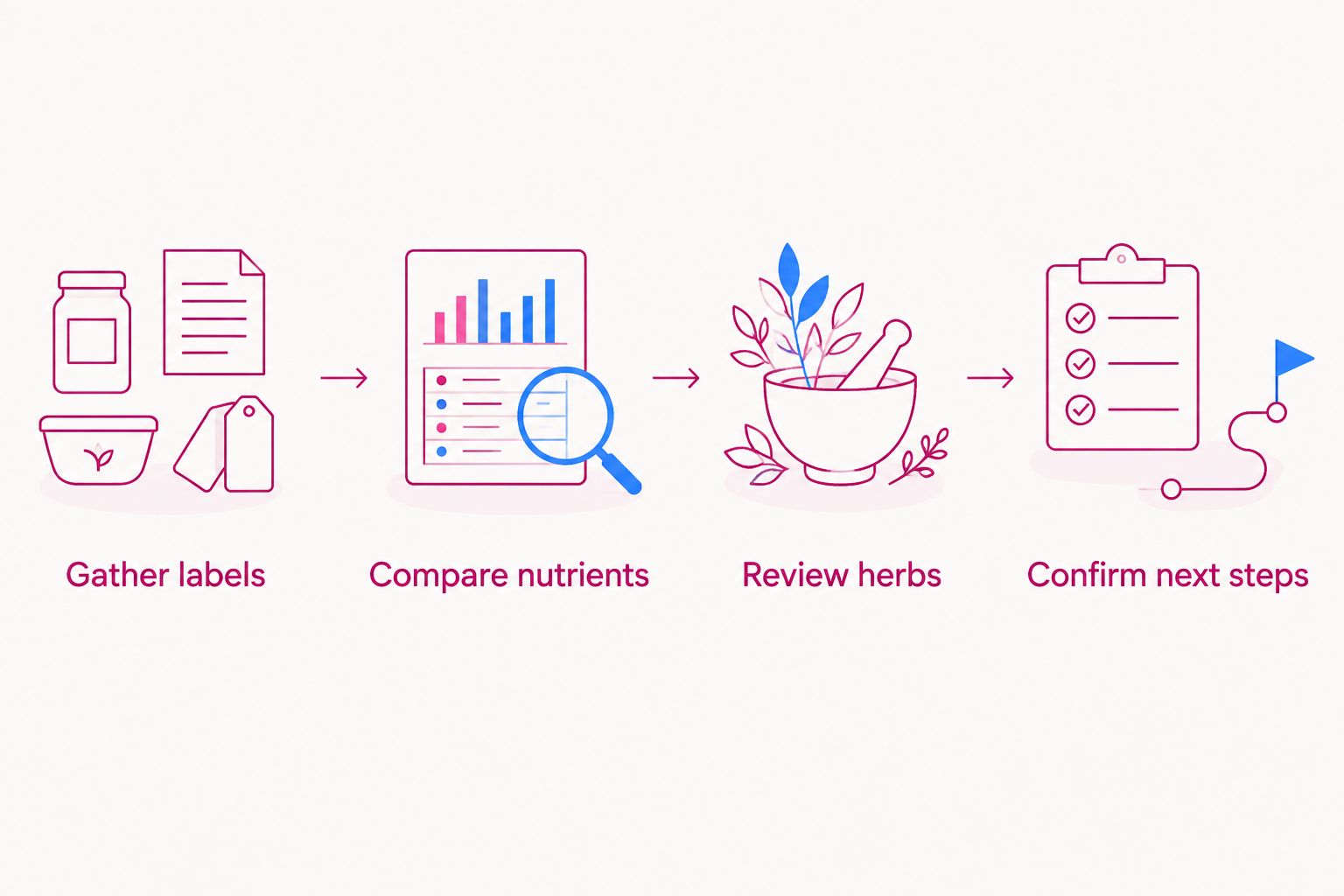
For a useful 2026 preconception conversation, gather the labels before your appointment. A list of product names alone leaves out nutrient amounts, herbal ingredients, and serving directions.
Gather labels
Include your prenatal, fertility products, separate vitamins, herbal teas, and other supplements. Add your medication list so your provider can review the whole routine together.
Photographs of the front label and Supplement Facts panel can help you keep the details organized. Include the directions and other ingredients, too.
Compare nutrients
Ask your provider to identify repeated nutrients across products. Folate, iron, and vitamin D are examples of nutrients to look for on labels, not instructions to add each one separately.
For your 2026 label review, distinguish folic acid from the broader term folate. CDC guidance for people who can become pregnant recommends 400 mcg of folic acid daily. The NIH Office of Dietary Supplements explains that folate labels can use dietary folate equivalents, or DFE, so the numbers require careful comparison.
Do not assume every folate form or label amount is interchangeable. Ask your provider how the recommendation applies to your current prenatal and whether any additional folate product is appropriate.
Review herbs
List each herbal ingredient rather than only the blend name. Ask your provider about your medications, your conception plans, and what should change once you become pregnant.
Do not leave tea out of this review. A product can be familiar as a beverage and still contain ingredients that warrant individual guidance.
Confirm next steps
Before you leave the appointment, confirm which products to use, which to leave out, and when to revisit the plan. Ask what to do after a positive pregnancy test rather than wait until that moment to find out.
Keep the answer simple enough to follow. You should know the purpose of every product in your routine.
How these options were compared
This guide compares formats and the product details provided for each option. It does not report a clinical trial, a head-to-head test, or a ranking by conception results.
The criteria are purpose, label transparency, prenatal overlap, format preference, herbal review, and a plan for pregnancy. For your 2026 choice, those questions provide a more useful decision process than a best-brand leaderboard.
The general folic acid guidance comes from the CDC's folic acid recommendations. Label terminology comes from the NIH Office of Dietary Supplements' Folate Fact Sheet for Consumers. Neither source is a product endorsement or a medical review of this article.
Which fertility supplement should you choose?
Start with your prenatal conversation, then choose an additional fertility supplement only for a provider-identified purpose. You do not need to add a gummy, a vitamin-containing formula, and a tea at the same time.
Choose Premium Fertility Gummies if your provider approves the formula and you prefer gummies. Discuss Fertility Support if you want a formula-focused review. Consider Fertility Tea only after a review of its herbs and your pregnancy plan.
If no additional product has a clear role, the right decision is to wait. You deserve an understandable routine, not pressure to purchase more.
FAQ
What's the best fertility supplement when I try to conceive?
The best choice is a product your healthcare provider recommends for a clear purpose after a full label review. Start with your prenatal plan, then assess whether an additional fertility supplement belongs in your routine.
Do fertility supplements replace a prenatal vitamin?
Do not assume that a fertility supplement replaces your prenatal vitamin. Ask your healthcare provider to compare the nutrient amounts and intended role of each product.
Are fertility gummies better than fertility tea?
A gummy format is not evidence that a product is more effective than a tea. Compare the complete formulas, your format preference, and your healthcare provider's advice.
Can I take fertility supplements with my prenatal?
Ask your healthcare provider to review both labels before you combine them. The review should include repeated nutrients, herbal ingredients, medications, and directions for each product.
How much folic acid does CDC guidance recommend?
CDC guidance for people who can become pregnant recommends 400 mcg of folic acid daily. Ask your healthcare provider how that recommendation applies to the form and amount listed on your prenatal label.
Should I keep a fertility supplement after a positive pregnancy test?
Ask your healthcare provider before you continue a fertility supplement during pregnancy. A product intended for a conception routine does not automatically belong in a pregnancy routine.
How long should I take fertility supplements before I expect results?
This comparison does not establish a timeline for conception results. Ask your healthcare provider how long to use a recommended product and when to reassess your overall plan.
One last thing
Before you add something new, write one sentence that explains why you would take it. If the only answer is that the label says fertility, pause and ask your provider for a clearer purpose.
For your 2026 routine, a shorter list with clear instructions is easier to understand than several products with overlapping roles. You do not need to make this decision alone.
Related guides
† These statements have not been evaluated by the Food and Drug Administration. This product is not intended to diagnose, treat, cure, or prevent any disease. Always consult your healthcare provider before starting any new supplement, especially during pregnancy, breastfeeding, or while managing a medical condition. Keep out of reach of children.