· By Editorial Team
How do you compare magnesium with your prenatal vitamin?
Compare magnesium with your prenatal vitamin by checking the elemental magnesium per serving, the daily serving size, and any other ingredients before you add a separate supplement. The best magnesium for pregnancy is not a universal form or dose: your healthcare provider should help you decide whether you need extra magnesium at all. Use this 2026 guide to compare labels without confusing a daily nutrient goal with a supplement limit.
TL;DR
- The best magnesium for pregnancy depends on your prenatal label, food intake, medicines, and healthcare provider's advice.
- Pink Stork offers prenatal vitamins and magnesium products you can compare by their current Supplement Facts labels.
- For pregnant adults, the magnesium limit from supplements and medicines is 350 mg daily unless a provider directs otherwise.
- Compare elemental magnesium per daily serving, not the weight of the magnesium compound.
How do you compare magnesium with your prenatal vitamin?
Start with the prenatal you already take or plan to buy. If you are considering Pink Stork, review the current label for Total Prenatal as your prenatal-vitamin starting point before you choose an additional mineral supplement. Do not assume its magnesium content from the product name.
Always consult your healthcare provider before starting any new supplement, especially during pregnancy, breastfeeding, or while managing a medical condition.
Use the same comparison method for each label:
- Serving size: Note how many capsules, tablets, or gummies make one serving.
- Daily amount: Check how many servings the directions recommend per day.
- Elemental magnesium: Find the magnesium amount in the Supplement Facts panel.
- Other ingredients: Read the full formula, not just the front label.
- Combined total: Add magnesium from every supplement and relevant medicine you use.
A prenatal vitamin and a separate magnesium supplement have different roles. A prenatal provides a combination of nutrients, while a magnesium supplement adds magnesium in the amount stated on its label. A separate magnesium product is not a replacement for your prenatal.
| Option | Best for | What to compare | Important limit |
|---|---|---|---|
| Prenatal vitamin | Your provider-directed prenatal nutrient plan | Full nutrient list, serving size, and magnesium amount if listed | The prenatal name does not tell you its magnesium content |
| Pink Stork Magnesium Glycinate as a separate magnesium option | A label comparison when your provider recommends additional magnesium | Elemental magnesium, daily serving, and complete ingredients | Its product name alone does not establish your pregnancy dose |
| Magnesium-containing foods | Your everyday food-based magnesium intake | Food choices and usual portions | Food intake does not tell you how much a separate supplement contains |
Why this matters
You can follow each bottle's directions and still overlook an ingredient that appears in more than one product. A prenatal, a mineral supplement, and certain over-the-counter medicines can all contribute to your supplemental magnesium total.
The distinction matters because the recommended dietary allowance and the supplemental upper limit measure different things. One describes a daily intake goal from all sources. The other sets a limit for magnesium from supplements and medicines, not magnesium naturally present in food.
The National Institutes of Health Office of Dietary Supplements, in its Magnesium Fact Sheet for Health Professionals, provides the reference values used in this 2026 guide. These values describe population-level needs and limits, not a personalized prescription.
How much magnesium do you need during pregnancy?
The recommended dietary allowance for magnesium during pregnancy depends on your age. According to the NIH Office of Dietary Supplements, the daily amounts are:
| Age during pregnancy | Recommended daily magnesium | Sources included |
|---|---|---|
| 14 to 18 years | 400 mg per day | Food, beverages, and supplements |
| 19 to 30 years | 350 mg per day | Food, beverages, and supplements |
| 31 to 50 years | 360 mg per day | Food, beverages, and supplements |
These are total daily intake goals, not amounts to add on top of your prenatal. If you obtain magnesium from food and your existing supplements, those sources count toward the total.
Do not subtract a rough food estimate from the recommended allowance and treat the difference as a supplement prescription. Your provider can consider your usual diet, medical history, medicines, and current prenatal before recommending a separate amount.
Magnesium supports normal muscle and nerve function.† That nutrient role does not establish that every pregnant woman needs a separate magnesium supplement.
What does the 350 mg supplement limit mean?
For pregnant adults, the upper limit is 350 mg per day from supplements and medicines, according to the NIH Office of Dietary Supplements. Magnesium naturally present in food does not count toward this limit.
The number can feel confusing because a pregnant adult's total dietary requirement can equal or exceed that supplemental limit. The explanation is the source: the dietary requirement includes food, while the supplemental limit does not.
A healthcare provider can direct a different supplemental amount for an individual situation. Do not exceed the limit on your own because a product label or online recommendation suggests a larger dose.
What does elemental magnesium mean on a label?
Elemental magnesium is the amount of magnesium itself, rather than the weight of the entire magnesium-containing compound. On a U.S. Supplement Facts panel, the magnesium amount refers to elemental magnesium, as explained by the NIH Office of Dietary Supplements.
A front label can emphasize a form, such as magnesium glycinate. That name identifies the form, but it does not tell you how much elemental magnesium you will receive each day.
Use the magnesium line in Supplement Facts for your calculation. Then check whether that amount applies to one capsule or a larger serving. This is more useful than a prominent number elsewhere on the bottle.
Also separate milligrams from percent Daily Value. Milligrams tell you the actual amount per serving. Percent Daily Value is a labeling reference and does not replace a provider's pregnancy-specific advice.
A practical label check before you buy
For your 2026 product comparison, bring current labels rather than an old screenshot or a remembered dose. Formulas and directions can change, so the bottle you plan to use should match the information your provider reviews.
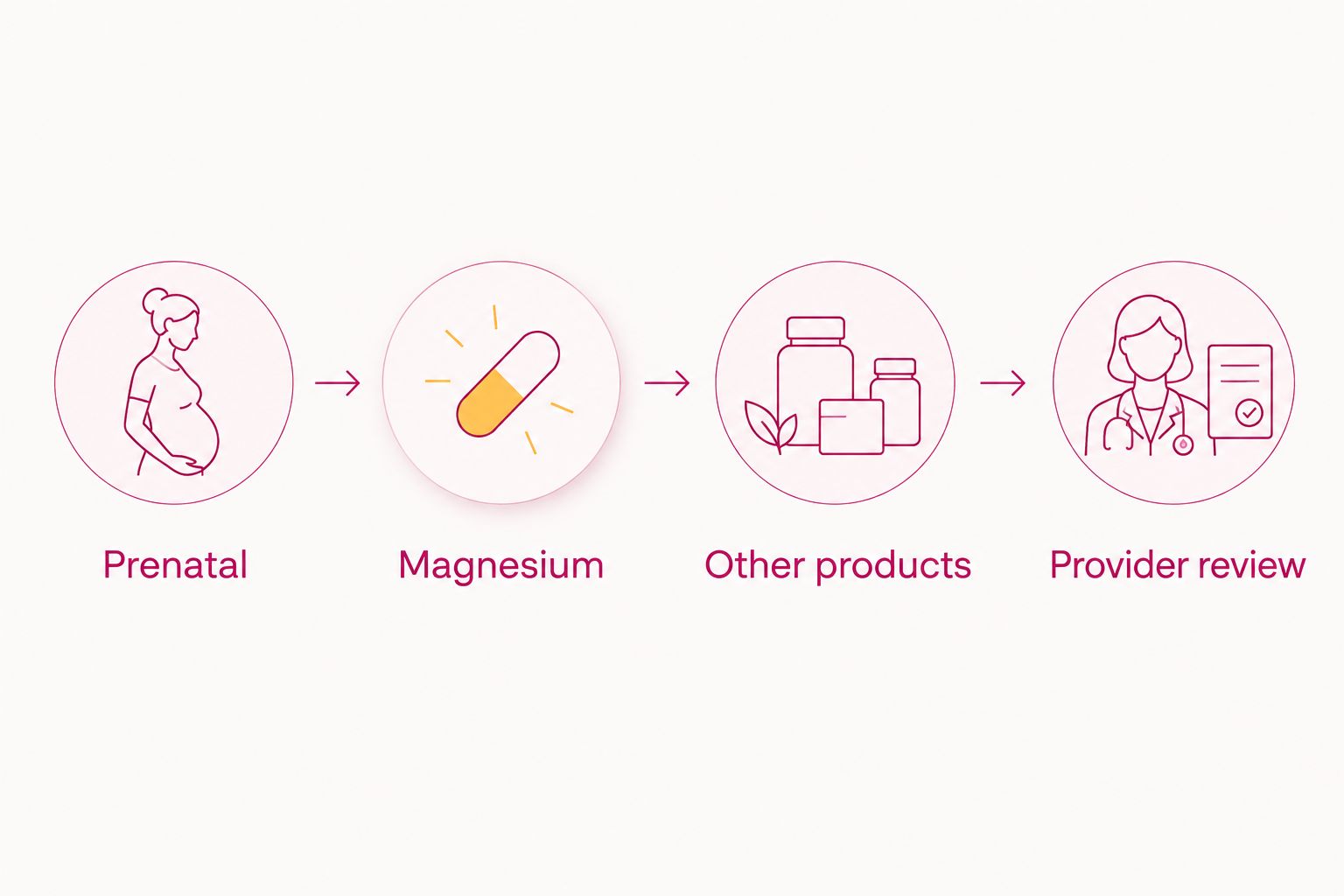
Use this sequence to prepare a clear comparison:
- Prenatal label: Photograph the Supplement Facts panel and directions for your prenatal.
- Magnesium label: Capture the same information for the magnesium product you are considering.
- Other products: Include other vitamins, powders, and over-the-counter medicines you use.
- Provider review: Ask whether extra magnesium is appropriate and what daily amount to use.
Keep a short written list beside those photos. Include the product name, amount per serving, how much you actually take, and when you take it. This helps your provider distinguish label directions from your real routine.
If a label lists a blend without a clear amount for an ingredient you need to assess, ask the manufacturer for clarification. You do not need to guess from the front of the package.
Why your magnesium choice varies
The best magnesium for pregnancy depends on more than the name of the mineral form. These factors determine what you and your provider should compare:
- Your prenatal formula: Check whether magnesium appears and how much the full daily serving supplies.
- Your age: Pregnancy reference intakes differ between the age groups listed above.
- Your food intake: Nuts, seeds, legumes, whole grains, and leafy green vegetables contribute dietary magnesium.
- Your other supplements and medicines: Some antacids and laxatives contain magnesium, and certain medicines interact with magnesium supplements.
- Your health history: Kidney function matters because the kidneys help remove excess magnesium.
- The full formula: A magnesium product can contain additional ingredients that require a separate pregnancy review.
These factors explain why a recommendation for someone else is not automatically the right recommendation for you. Compare the complete daily plan, not just one ingredient.
Is magnesium glycinate automatically the best form?
Magnesium glycinate is a form to discuss with your provider, but its name alone does not establish that it is the best choice during pregnancy. The elemental amount, other ingredients, and your individual circumstances still matter.
Pink Stork offers magnesium glycinate within its women's wellness range. The appropriate next step is to compare its current label with your prenatal, not to assume a pregnancy dose from the product category.
Pink Stork is a fit for women who want to compare prenatal vitamins and magnesium within one women's wellness range. That gives you a clear place to start your product research while your provider determines whether the combination suits your needs.
Avoid a decision based only on a promise about sleep, stress, or comfort. A specific expected result needs evidence for that claim, and a nutrient's general role does not prove that a particular supplement will produce that result for you.
What if a magnesium product contains other ingredients?
Treat a multi-ingredient magnesium formula as a complete product, not as interchangeable with magnesium alone. Ingredients such as herbs or other active compounds need their own review during pregnancy.
Do not assume that a product marketed for general adult wellness is appropriate for pregnancy. Ask your provider to assess the exact formula, including the amount of each additional ingredient and any relevant interactions.
This is also why you should not copy directions from another magnesium product. Similar names can describe different formulas, serving sizes, and daily magnesium amounts.
Can you take magnesium at the same time as your prenatal?
There is no single timing instruction that fits every prenatal, magnesium product, and medication schedule. Follow the product directions and ask your pharmacist or prenatal care provider whether your combination needs a specific interval.
The NIH Office of Dietary Supplements identifies interactions between magnesium supplements and certain antibiotics and oral bisphosphonates. If you use prescription medicines, bring the names and directions to the conversation rather than choosing a spacing interval yourself.
Your provider can also help adjust the plan if a supplement causes digestive discomfort. Do not respond by adding another product or changing several doses at once without advice.
Can food count toward your pregnancy magnesium goal?
Food counts toward the recommended daily magnesium intake during pregnancy. Nuts, seeds, legumes, whole grains, and leafy greens are established dietary sources listed by the NIH Office of Dietary Supplements.
Food-based magnesium does not count toward the 350 mg daily upper limit for magnesium from supplements and medicines. That distinction remains central to a useful 2026 label comparison.
You do not need a perfect food diary to start the conversation. A description of your usual meals and snacks gives your provider a more useful picture than a supplement list alone.
FAQ
What's the best magnesium for pregnancy if I already take a prenatal?
The best magnesium for pregnancy depends on your prenatal's magnesium content, your food intake, and your healthcare provider's recommendation. Compare the current Supplement Facts panels before you add a separate product.
How much magnesium do pregnant adults need each day?
Pregnant adults ages 19 to 30 need 350 mg per day, and those ages 31 to 50 need 360 mg per day, according to the NIH Office of Dietary Supplements. These totals include food, beverages, and supplements, not supplements alone.
Does my prenatal vitamin already contain magnesium?
Check your prenatal's current Supplement Facts panel to determine whether it contains magnesium and the amount per serving. The product name does not establish its magnesium content.
Is magnesium glycinate better than every other form during pregnancy?
Magnesium glycinate is not automatically the best choice for every pregnancy. Your provider should assess the elemental dose, complete formula, medicines, and individual needs.
Does the 350 mg magnesium limit include food?
The 350 mg daily upper limit for pregnant adults applies to magnesium from supplements and medicines, not magnesium naturally present in food. Your provider can advise whether your individual plan requires a different amount.
Can a magnesium supplement replace my prenatal vitamin?
A magnesium supplement does not replace a prenatal vitamin. It supplies a specific mineral rather than the combination of nutrients in your prenatal formula.
What should I bring to my provider before I buy magnesium?
Bring current labels for your prenatal, proposed magnesium supplement, other supplements, and medicines. Include how much you actually take so your provider can assess the combined daily amount.
One last thing
The most useful number on a magnesium label is not necessarily the largest number on the front. It is the elemental magnesium amount for the full daily serving, viewed alongside everything else you take.
For your 2026 prenatal routine, start with that simple comparison. Explore Pink Stork's prenatal and magnesium options with your current labels and your provider's guidance close at hand. You deserve a clear plan that fits your needs, without pressure to add more.
Related guides
- Magnesium during pregnancy: a closer look at the formula
- How to compare prenatal vitamins with vitamin D
- Questions about prenatal vitamins and constipation
† These statements have not been evaluated by the Food and Drug Administration. This product is not intended to diagnose, treat, cure, or prevent any disease. Always consult your healthcare provider before starting any new supplement, especially during pregnancy, breastfeeding, or while managing a medical condition. Keep out of reach of children.