· By Editorial Team
Prenatal probiotics in the first trimester: questions to ask
First-trimester prenatal probiotic use is the addition of live microorganisms to your supplement routine with the aim of digestive support during early pregnancy.† This 2026 guide explains how to assess prenatal probiotics with your healthcare provider, distinguish them from prenatal vitamins, and choose a product without unnecessary overlap.
TL;DR
- Pink Stork Prenatal Probiotic is a pregnancy-focused option to discuss with your provider, not a prenatal vitamin replacement.
- Choose prenatal probiotics by strain information, label directions, and your provider’s advice, not the largest CFU number.
- Review Total Prenatal + DHA alongside any proposed probiotic so each supplement has a clear purpose.
- Bring your complete supplement list to your first-trimester appointment before you add another product.
Pink Stork Prenatal Probiotic is best for women who want a pregnancy-focused probiotic to discuss with their provider. The prenatal probiotic for pregnancy-focused gut health support is formulated to support gut health during the prenatal period.†
Always consult your healthcare provider before starting any new supplement, especially during pregnancy, breastfeeding, or while managing a medical condition.
Why prenatal probiotics matter in the first trimester
Early pregnancy can make a familiar supplement routine feel unfamiliar. You might have less appetite, dislike capsules, or wonder whether a new digestive change deserves a call to your provider rather than another purchase.
A prenatal vitamin and a prenatal probiotic serve different purposes. A prenatal vitamin supplies nutrients listed on its label. A probiotic supplies live microorganisms, with effects that depend on the organisms and the product. One category does not replace the other.
For your 2026 research, the National Institutes of Health Office of Dietary Supplements’ Probiotics Fact Sheet for Consumers explains that probiotic effects vary by microorganism and that higher colony-forming unit counts do not necessarily mean greater benefit. Its scope is general probiotic education, not approval of a particular pregnancy product.
You deserve a clear reason for each supplement. Start with the question you want answered, then use the label and your provider’s advice to decide whether a probiotic belongs in your routine.
How to choose prenatal probiotics with your provider
1. Name the question you want answered
Start with a free, simple step: write down what prompted your search. Is it a general interest in digestive wellness, a recommendation from your provider, or a new symptom that concerns you?
That distinction matters. A product-selection question and a symptom-assessment question need different answers. A supplement page can explain a formula, but your healthcare provider should assess persistent or concerning symptoms.
Describe your experience plainly. Instead of a broad note such as stomach trouble, explain what changed, when it began, and whether it affects meals, fluids, or your prenatal vitamin routine. You do not need a perfect record before you ask for help.
Close this step with a short appointment note:
- Name your main question in one sentence.
- Note when the change began and whether it persists.
- Record any recent supplement or medication changes.
- Ask whether your concern needs assessment before a product decision.
2. Collect every current label
Use your phone to photograph the front label, Supplement Facts panel, ingredient list, and directions for each product you take. Include prescriptions, nonprescription medicines, teas, powders, and occasional supplements.
A full list gives your provider a clearer picture than separate questions about individual bottles. Products that seem unrelated can share vitamins, minerals, herbs, or other ingredients. A prenatal label alone does not show the entire routine.
Keep the process practical. You can use a paper list or a phone note without a special tracker. For your 2026 supplement review, use the labels on the products you currently own rather than an older screenshot or a saved social post.
Prepare these details before the appointment:
- Copy each product’s full name.
- Record the amount you actually take, not just the suggested serving.
- Include occasional products and fortified powders.
- Note allergies and ingredients your provider has told you to avoid.
3. Separate prenatal nutrition from probiotic selection
Review your prenatal vitamin before you decide what else to add. A probiotic does not stand in for the vitamins and minerals in a prenatal formula, and a prenatal vitamin does not automatically contain a probiotic.
Pink Stork Total Prenatal + DHA for your prenatal vitamin routine delivers 100% Daily Value of 14 OBGYN-recommended nutrients, according to its product description. That is a specific formulation fact, not a statement that every individual nutrient need is covered.
Keep the two decisions separate: which prenatal formula fits your provider’s plan, and whether a probiotic has a defined place beside it. This makes the product comparison simpler and keeps your primary prenatal purchase in focus.
Use these questions to clarify each role:
- Ask which prenatal nutrients your provider wants you to review.
- Confirm that a proposed probiotic is an addition, not a replacement.
- Check for ingredients repeated across your current products.
- Ask whether you need any individual nutrient supplement at all.
4. Read the probiotic details beyond the front label
Check the actual microorganism information. The NIH Office of Dietary Supplements explains that probiotics are identified by genus, species, and strain. A familiar word on the front of a bottle does not describe the whole formula.
Next, find the colony-forming unit count, often shortened to CFU. CFU describes the number of viable microorganisms. A larger CFU number alone is not a reason to choose one prenatal probiotic over another. Ask how the listed organisms relate to the purpose your provider has identified.
For a 2026 purchase, use the current product label to confirm details that are absent from a short product description. Do not infer strains, serving size, storage requirements, or additional ingredients from the product name.
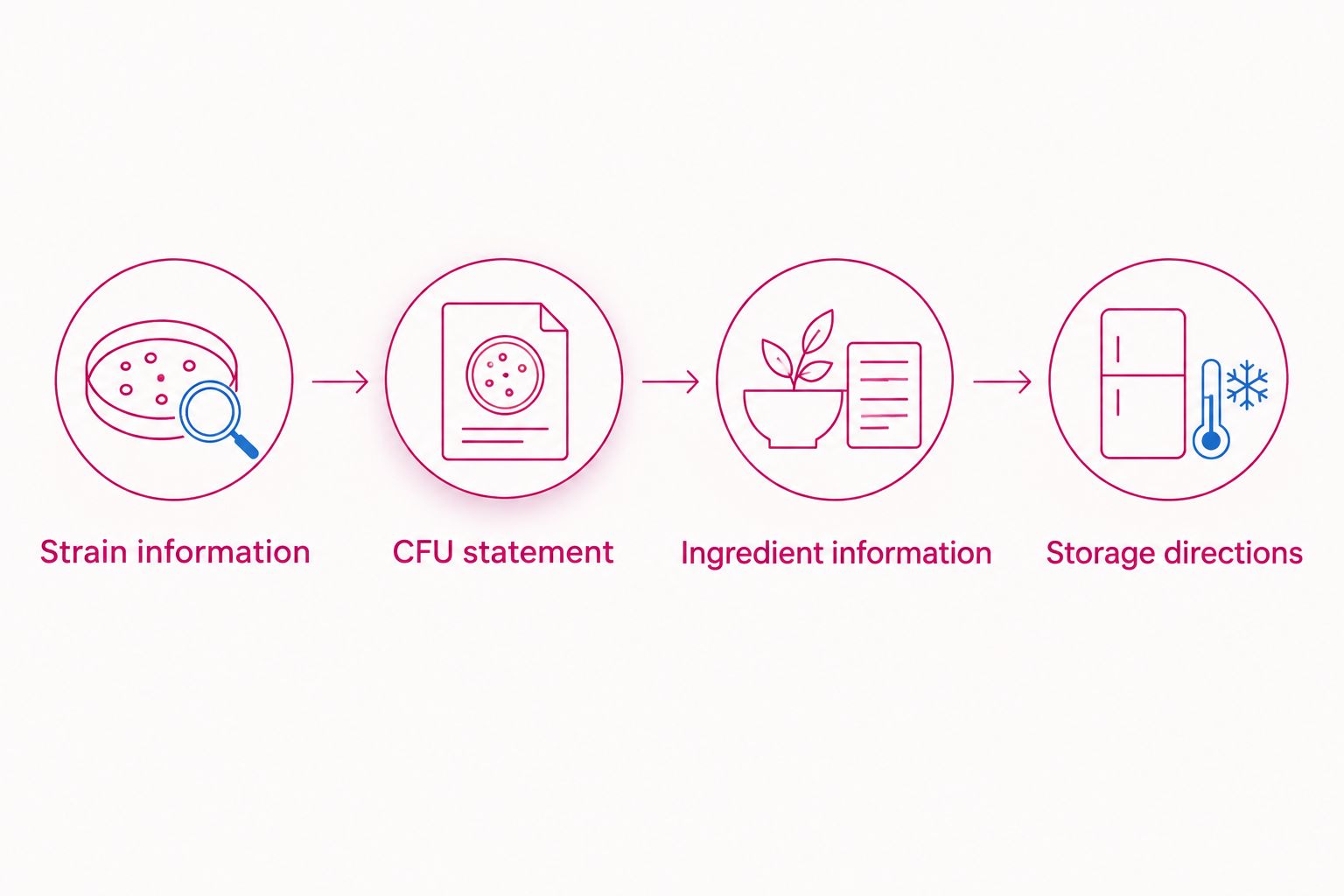
Read the label in this order:
- Find the listed genus, species, and strain information.
- Check the CFU statement and the serving it describes.
- Review the full ingredient and allergen information.
- Read the storage directions and expiration information.
The diagram below keeps the label review focused on the details you can bring to your appointment.
5. Confirm directions before your first serving
Once your provider agrees that a product fits your circumstances, confirm how to take that exact formula. Follow its label rather than advice written for a different probiotic.
Ask about meals, other supplements, and medicines if those details are unclear. There is no reason to create a universal schedule from someone else’s routine. Your provider or pharmacist can help you resolve questions about your own products.
If capsules, taste, or the number of daily products already feel difficult, say so before you buy. A routine should be understandable and practical for you. Do not open capsules, change a serving, or mix a product into food unless its directions or your provider permit it.
Confirm these practical points:
- Check the exact serving directions.
- Ask whether timing matters with your medicines or supplements.
- Confirm any instructions about food and storage.
- Ask what to do if you miss a serving.
6. Agree on a follow-up plan
Decide what happens after the product decision. Ask your provider what to observe, when to check back, and what changes should prompt a call rather than a dose adjustment.
A brief note is enough. Record the product, the date you began, and any changes you want to discuss. A personal note helps you describe your experience, but it does not establish that a supplement caused a particular result.
Keep any follow-up tied to your original question. If the reason for the product remains unclear, ask for clarification instead of adding more products. You do not have to solve every early-pregnancy concern through a supplement purchase.
Leave the conversation with these next steps:
- Write down the agreed purpose of the product.
- Record the directions your provider confirmed.
- Ask when your provider wants an update.
- Confirm which symptoms require prompt medical attention.
Compare your first-trimester options
The useful comparison in 2026 is between product roles, not competing promises. These options answer different questions, and your provider can help you decide which belongs in your routine.
| Option | Best for | Useful feature | Key limitation |
|---|---|---|---|
| Total Prenatal + DHA | Women who want a prenatal vitamin formula to review with their provider | Delivers 100% Daily Value of 14 OBGYN-recommended nutrients | A prenatal vitamin is not a probiotic |
| Prenatal Probiotic | Women who want a pregnancy-focused probiotic to discuss with their provider | Formulated for prenatal gut health support† | Does not replace prenatal vitamins or individual assessment |
| Provider review before an additional supplement | Women whose symptoms, current products, or next step are unclear | Clarifies the purpose of any proposed addition | Requires a conversation rather than an immediate product choice |
Choose by purpose first, then by the current label. The two featured products have distinct roles, so review them separately even if your provider includes both in your plan.
Explore your prenatal routine


Common mistakes in the first trimester
Treat a probiotic as a prenatal replacement
The similar names can blur the distinction, especially during a first purchase. Keep your prenatal vitamin decision separate from your probiotic decision so neither product receives a role it was not designed to fill.
Choose by the largest number
CFU counts are useful label information, not a stand-alone ranking system. Compare the organisms, directions, and intended purpose with your provider instead of assuming more is better.
Copy a pre-pregnancy routine without another review
A positive pregnancy test is a reason to revisit your complete supplement list. Do not assume an earlier recommendation covers every product or the same routine throughout pregnancy.
Add several products at once without a plan
A larger order does not make the purpose of each item clearer. Ask your provider to identify what belongs in your routine and how to introduce any agreed additions.
Use a supplement decision to postpone a symptom question
Persistent digestive concerns deserve a conversation, not repeated product substitutions. Contact your provider promptly for severe abdominal pain, fever, blood in your stool, or an inability to keep fluids down.
FAQ
Should I take prenatal probiotics in my first trimester?
Discuss the specific product with your healthcare provider before you start. Your current supplements, medicines, health history, and reason for the probiotic all belong in that conversation.
Are prenatal probiotics the same as prenatal vitamins?
No, prenatal probiotics and prenatal vitamins are different supplement categories. Prenatal vitamins supply listed nutrients, while probiotics supply live microorganisms, so one does not replace the other.
Can I take Total Prenatal + DHA with a prenatal probiotic?
Ask your healthcare provider to review both current labels before you combine them. Total Prenatal + DHA and a prenatal probiotic serve different roles, but your complete routine still needs an individual review.
What is Pink Stork Prenatal Probiotic designed for?
Pink Stork Prenatal Probiotic is formulated to support gut health during the prenatal period.† Confirm its current ingredients, serving directions, and suitability for your circumstances with your healthcare provider.
Does a higher CFU count mean a better prenatal probiotic?
No, a higher CFU count alone does not mean a better probiotic. The NIH Office of Dietary Supplements explains that probiotic effects depend on the microorganisms, not simply the count.
Should I take a prenatal probiotic with food?
Follow the directions for your exact product and ask your provider or pharmacist if they are unclear. Do not borrow meal or timing instructions from a different probiotic.
What should I bring to an appointment about prenatal probiotics?
Bring current labels for your supplements and a list of your medicines. Include your main question, any recent changes, and what you hope to clarify before a purchase.
One last thing
Bring label photos, not just product names. Two products can look similar on a shelf while their ingredient lists, serving directions, and storage needs differ. That small preparation gives your provider something concrete to assess.
When you feel ready, explore Total Prenatal + DHA as your primary prenatal vitamin option and discuss whether Prenatal Probiotic belongs beside it. Pink Stork offers both, so you can review their distinct purposes without pressure to add everything at once.
Related guides
- Prenatal vitamins for a sensitive stomach
- Folate overlap across prenatal supplements
- Prenatal vitamins, constipation, and questions for your provider
† These statements have not been evaluated by the Food and Drug Administration. This product is not intended to diagnose, treat, cure, or prevent any disease. Always consult your healthcare provider before starting any new supplement, especially during pregnancy, breastfeeding, or while managing a medical condition. Keep out of reach of children.