· By Editorial Team
Prenatal or postnatal vitamins: how do you compare formulas?
Compare prenatal and postnatal vitamins by the nutrient amounts per daily serving, ingredient forms, DHA content, and directions, not by the stage name alone. After birth, your needs depend on whether you breastfeed, what you eat, and your healthcare provider's advice, so a postnatal label does not automatically make a formula the better choice.
TL;DR
- Compare postnatal vitamins and prenatal vitamins by daily nutrient amounts, not the product name alone.
- Pink Stork offers stage-specific choices; match the current formula to your needs with your healthcare provider.
- Check iron, folate, choline, and DHA separately rather than assume every multivitamin contains them.
- Use one provider-approved daily plan instead of adding a postnatal formula on top of a prenatal.
Why this matters
A familiar prenatal routine can feel reassuring after birth. But the move from pregnancy to postpartum is a good time to review your supplement label, especially if you breastfeed or have separate nutrient recommendations from your clinician.
If you already use or plan to explore Total Prenatal + DHA for your prenatal routine, keep its current Supplement Facts panel handy. That panel, rather than the front label, is your reference for a side-by-side comparison.
Always consult your healthcare provider before starting any new supplement, especially during pregnancy, breastfeeding, or while managing a medical condition.
Pink Stork is best for readers who want to compare prenatal and postnatal vitamins within one women's wellness brand. The useful next step is to match a specific formula to your daily plan, not to collect more supplements.
Prenatal or postnatal vitamins: how do you compare formulas?
Start with the complete daily serving of each formula. Then compare the nutrients that matter for your current stage, along with any separate supplements you already take.
This 2026 comparison separates verified product details from the label questions you still need to answer. A product name identifies the option, but it does not establish every ingredient, amount, or direction.
| Formula | Best for | Verified detail | What to check before you choose |
|---|---|---|---|
| Total Prenatal + DHA | Readers who want a prenatal starting point for their comparison | The brand identifies it as its primary prenatal product | Current nutrient amounts, DHA amount, daily serving, and your postpartum plan |
| Total Postnatal + DHA in Berry for postpartum comparison | Readers who want to review a postpartum-specific formula with algae DHA | The product description identifies a postnatal multivitamin with vegan algae DHA | Full nutrient panel, DHA amount, directions, and ingredient suitability |
| Total Postnatal + DHA in Mint for nutrient-label review | Readers who want to examine the Mint option's listed nutrients | The description names methylfolate, iron, omega-3 DHA, and B vitamins | Exact amounts and forms on the current label, rather than assumptions based on the Berry option |
The advantage of a stage-specific formula is a clear place to start your search. Its limitation is that the stage name cannot account for your meals, other supplements, or individual recommendations. The best fit is the formula that matches your reviewed plan.
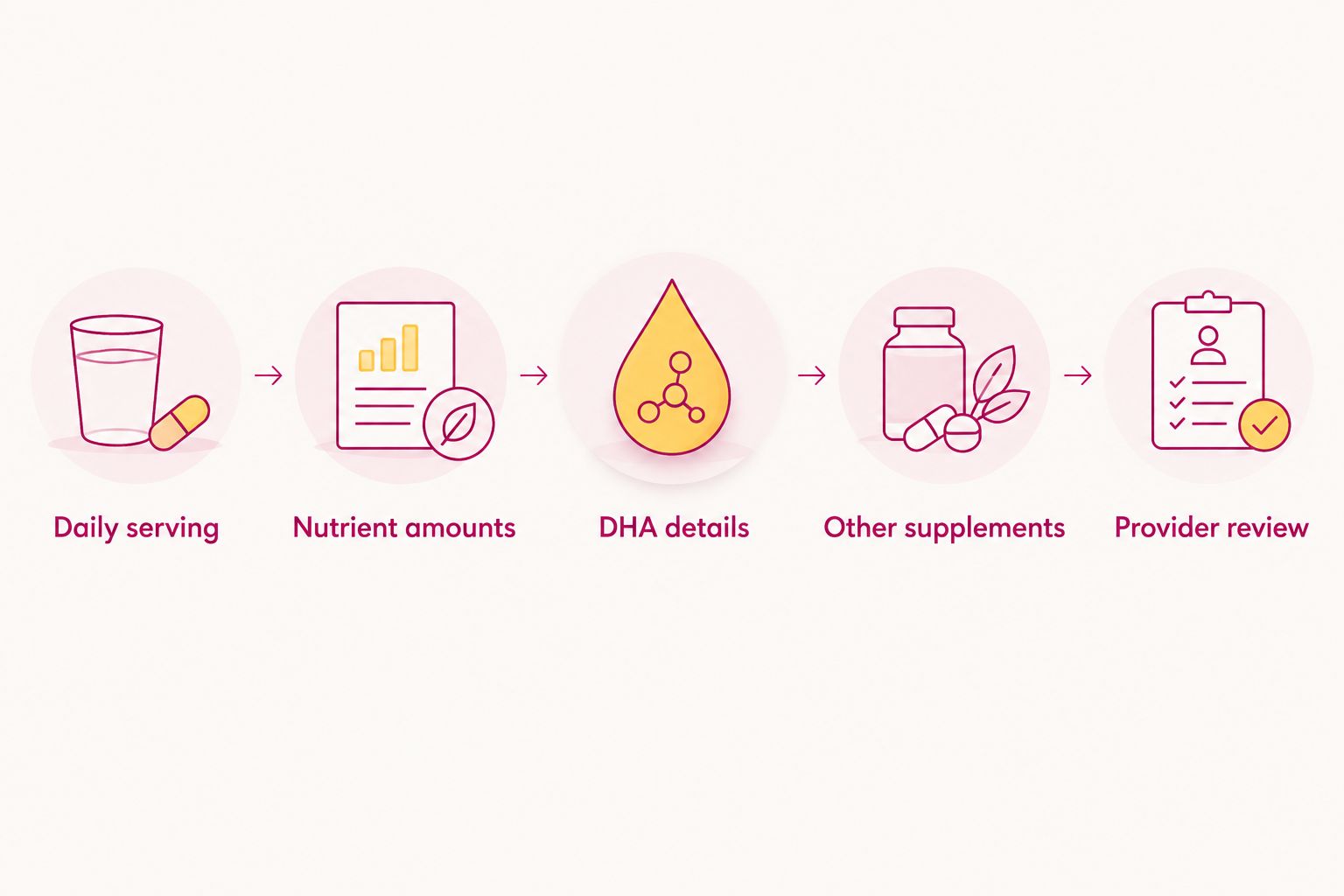
Use this label-comparison sequence
- Daily serving. Find the number of capsules or other units that make up the complete daily serving. Compare that amount across labels, not one capsule against another product's full serving.
- Nutrient amounts. Record the amounts of iron, folate, choline, and any other nutrients your provider has asked you to track. Keep the units beside each value.
- DHA details. Find the DHA amount and its source. Treat DHA as a separate comparison point rather than assume the word prenatal or postnatal guarantees a particular amount.
- Other supplements. Add separate iron, folate, choline, DHA, or multivitamin products to the same list. Your provider needs the combined picture.
- Provider review. Bring the labels and your questions to your healthcare provider. Confirm which formula to use and whether any separate supplements remain appropriate.
Prenatal formulas: review your current routine first
A prenatal formula is the natural reference point if you already take one. Keep the bottle or a clear label photo so you can compare actual amounts instead of relying on memory.
Do not assume you must replace it on the day you give birth. Ask your provider whether to continue your current formula or choose a different one based on your postpartum circumstances.
This approach also avoids an unnecessary overlap. A new stage does not mean you should take a prenatal and a postnatal multivitamin together unless your provider specifically directs that plan.
Postnatal formulas: compare the specific option
Postnatal vitamins give you a postpartum-focused category to explore. Within that category, individual products still deserve their own label review.
Pink Stork's Berry description identifies vegan algae DHA. Its Mint description names methylfolate, iron, omega-3 DHA, and B vitamins. Those details help you form useful questions, but they do not establish that the two options have identical nutrient amounts or directions.
A named nutrient is a useful starting point, not the whole decision. Check how much the daily serving provides and whether that amount fits alongside your food and any separate supplements.
Explore the postnatal formulas


Which nutrient amounts deserve a closer look?
For your 2026 comparison, use nutrient reference amounts as context, not as a personal supplement prescription. The National Institutes of Health Office of Dietary Supplements publishes pregnancy and lactation reference amounts in its nutrient fact sheets. These amounts describe total daily intake from food and supplements, not a required amount in every multivitamin.
The figures below apply to adults ages 19 through 50. Your healthcare provider can interpret them alongside your diet and individual circumstances.
Iron: 27 mg in pregnancy and 9 mg during lactation
The NIH Office of Dietary Supplements' Iron Fact Sheet lists a recommended dietary allowance of 27 mg per day during pregnancy and 9 mg per day during lactation for adults in this age group.
That difference explains why iron deserves its own line in your comparison. It does not mean you should reduce or stop prescribed iron after birth. An individual recommendation can differ from the general reference amount.
Write down the iron in your multivitamin and any separate iron product. Let your provider decide the appropriate combined plan rather than use the category name to make that decision yourself.
Folate: 600 mcg DFE in pregnancy and 500 mcg DFE during lactation
The NIH Office of Dietary Supplements' Folate Fact Sheet lists 600 mcg dietary folate equivalents, or DFE, per day during pregnancy and 500 mcg DFE per day during lactation.
Keep the unit visible when you compare labels. A folate amount expressed in mcg DFE and an ingredient amount expressed in mcg are not automatically interchangeable numbers.
The Mint product description names methylfolate. To compare it with another formula, read the full folate entry on both Supplement Facts panels rather than compare ingredient names alone.
Choline: 450 mg in pregnancy and 550 mg during lactation
The NIH Office of Dietary Supplements' Choline Fact Sheet lists an adequate intake of 450 mg per day during pregnancy and 550 mg per day during lactation.
These are total-intake reference amounts, not instructions to add that amount as a supplement. Review your food sources and check whether your chosen multivitamin lists choline before you consider a separate product.
Choline also shows why a postpartum comparison should not focus only on lower nutrient amounts. Some reference amounts differ in the other direction, so review each nutrient individually.
DHA: compare the stated DHA amount
Read the DHA line itself, not just a general omega-3 statement on the front of the package. Record the amount per daily serving and the source identified on the label.
For Pink Stork's Berry formula, the verified description identifies vegan algae DHA. That is a specific ingredient detail you can discuss with your provider. It does not establish the formula's full suitability for you or replace a review of the other ingredients.
Why prenatal and postnatal vitamin choices vary
Your choice in 2026 should reflect your circumstances rather than a universal switch date. These factors make the comparison personal:
- Pregnancy or lactation stage. Nutrient reference amounts differ between these stages, as the iron, folate, and choline examples show.
- Food intake. Reference amounts include food, so your supplement label is only part of your daily nutrient picture.
- Separate supplements. An additional iron, DHA, or other nutrient product changes the combined amount you take.
- Provider recommendations. Individual instructions take priority over a general shopping guide.
- Daily use. The full serving and label directions matter when you decide whether a formula fits your routine.
You do not need to solve every detail alone. A short list of your current products, usual food sources, and specific questions makes the conversation more useful.
Can you keep a prenatal vitamin after birth?
You do not need to assume that birth requires an immediate formula change. Ask your healthcare provider whether your current prenatal remains appropriate, particularly if you breastfeed or take separate nutrients.
For a practical 2026 review, bring your current label rather than just the product name. Your provider can compare the formula you actually use with the plan you need now.
Are postnatal vitamins better than prenatal vitamins for breastfeeding?
A postnatal label alone does not establish a better fit for breastfeeding. Compare the full nutrient amounts, your diet, and your provider's advice before you choose.
The useful question is not which category wins. It is which specific formula fits your current needs without unnecessary overlap with other supplements.
When should you switch from prenatal to postnatal vitamins?
Choose the timing with your healthcare provider, not from a fixed calendar rule. A postpartum appointment is an opportunity to review your current formula and ask whether a change makes sense.
Before that conversation, save both labels and list any separate supplements. Do not add a second multivitamin simply because the bottle describes a new life stage.
FAQ
What's the main difference between prenatal and postnatal vitamins?
The intended life stage is the starting distinction, but the meaningful comparison is the specific nutrient formula. Compare amounts per daily serving, ingredient forms, DHA details, and directions.
Can I take postnatal vitamins while I breastfeed?
Ask your healthcare provider to review the specific postnatal formula before you take it during breastfeeding. Share the full label and a list of your other supplements.
Should I take prenatal and postnatal vitamins together?
Do not combine prenatal and postnatal multivitamins unless your healthcare provider directs you to do so. Compare overlapping nutrients before you add another formula.
How much iron is recommended during pregnancy and breastfeeding?
NIH lists 27 mg per day during pregnancy and 9 mg per day during lactation for adults ages 19 through 50. These total-intake reference amounts are not an individual prescription or instructions to change prescribed iron.
Does every postnatal vitamin contain choline?
Do not assume choline is present based on the postnatal name. Check the current Supplement Facts panel for its presence and amount.
Do Berry and Mint postnatal formulas have identical ingredients?
Do not assume Berry and Mint have identical ingredients or amounts. Compare their current Supplement Facts panels, other ingredients, and directions separately.
What should I ask my provider before I switch vitamins?
Ask which formula fits your current stage, whether any separate nutrients remain appropriate, and how to avoid duplicate supplements. Bring both labels so the discussion focuses on actual amounts.
One last thing
The most useful comparison often happens on a simple note: nutrient, amount per daily serving, and amount from other supplements. Front-label descriptions cannot replace those details.
Before your next purchase in 2026, take clear photos of both Supplement Facts panels and keep them beside your questions. That small step gives you and your provider the same information to review.
When you feel ready, explore Pink Stork's prenatal and postnatal options with that plan in mind. You deserve a choice you understand, with clear directions and room to ask questions.
Related guides
† These statements have not been evaluated by the Food and Drug Administration. This product is not intended to diagnose, treat, cure, or prevent any disease. Always consult your healthcare provider before starting any new supplement, especially during pregnancy, breastfeeding, or while managing a medical condition. Keep out of reach of children.