· By Editorial Team
Pregnancy must-haves: how to keep your supplement shelf simple
Pregnant women's supplement essentials are the products you and your healthcare provider choose to meet your nutritional needs, with the aim of a clear, manageable daily plan. Your pregnancy must haves should reflect your diet, prenatal label, and individual guidance, not every bottle on a registry checklist.
TL;DR
- Keep pregnancy must haves focused: one provider-reviewed prenatal plan, clear label instructions, and only purposeful additions.
- Pink Stork prenatal vitamins suit women who want a pregnancy-focused starting point for a provider conversation.
- Compare nutrient amounts across prenatal vitamins and separate supplements before you combine them.
- Choose a format you can take as directed, and keep your healthcare provider informed about changes.
Why a simple supplement shelf matters during pregnancy
A crowded shelf makes it harder to tell what you take, how much you take, and which instructions belong to which bottle. Pregnancy also changes the questions you need to ask about products you already own, including vitamins, powders, and herbal teas.
A useful supplement plan gives every product a clear purpose. Start with your current labels and a conversation with your prenatal care team. If folate terminology feels confusing, the guide to folate supplements for pregnancy offers a focused topic to explore before your appointment.
For your 2026 pregnancy checklist, separate nutritional essentials from optional purchases. A product can belong in a pregnancy collection without being necessary for every pregnant woman.
Build your pregnancy supplement plan in six steps
1. Gather every supplement you already use
Start with a free shelf audit before you buy anything. Put your vitamins, mineral supplements, protein powders, and wellness teas together, then photograph each label, including the Supplement Facts or Nutrition Facts panel and directions.
Include products you take occasionally. A gummy from your desk drawer or a powder from the kitchen still belongs on the list your healthcare provider reviews.
Create a short note with each product's name, amount per serving, and how often you actually take it. Record your real routine rather than the routine you intended to follow. That distinction helps your provider understand your current intake.
Your 2026 inventory does not need a special planner. A phone note and readable label photos are enough.
- Gather vitamins, powders, teas, and occasional supplements.
- Photograph the full label, not just the front panel.
- Record the serving size and your usual use.
- Note prescription and nonprescription medicines separately.
- Bring the list to your prenatal appointment.
2. Compare labels with pregnancy nutrient guidance
Read the amount per serving before you compare product names. Then ask your healthcare provider how your prenatal, food choices, and any separate supplements fit together.
The National Institutes of Health Office of Dietary Supplements lists pregnancy recommended dietary allowances of 600 mcg dietary folate equivalents (DFE) for folate, 27 mg for iron, and 450 mg for choline in its nutrient fact sheets. Use these established reference values during your 2026 label review, not as instructions to buy those amounts in separate supplements.
These values describe total daily intake from relevant sources. They are not a universal add-on prescription, and a label's percentage of Daily Value is not your personal care plan. Folate labels also use terminology that deserves careful attention, so ask your provider to interpret the units rather than compare unlike numbers.
- Check the amount per serving.
- Read the serving size before you count capsules or gummies.
- Compare the same nutrient units across labels.
- Include food sources in your provider conversation.
- Ask which nutrients deserve individual attention.
3. Choose one prenatal as your starting point
After your label review, choose a prenatal with your healthcare provider rather than assemble several overlapping multivitamins yourself. Pink Stork's Total Prenatal option for your pregnancy supplement plan is a place to start that conversation. The brand also identifies Total Prenatal + DHA among the products in its Pregnancy Regimen.
Always consult your healthcare provider before starting any new supplement, especially during pregnancy, breastfeeding, or while managing a medical condition.
Pink Stork prenatal vitamins are best for women who want a pregnancy-focused product to review with their healthcare provider. Confirm the current product label, directions, and ingredient information before you choose. A product name alone does not establish every nutrient amount or whether the formula matches your needs.
Pink Stork sells doctor-formulated supplements, but that does not replace individual guidance. Your provider can assess the formula alongside your diet, medicines, and other products.
- Review the current prenatal label with your provider.
- Confirm the full daily serving.
- Check ingredients against any known allergies.
- Ask which existing products the prenatal would replace.
- Keep the selected product's directions accessible.
4. Add a separate product only for a clear reason
A separate nutrient belongs on your shelf when your healthcare provider identifies a reason for it, not simply because it appears on a pregnancy shopping list. The same approach applies to DHA, choline, iron, and other additions.
Check your prenatal first. Then ask your provider to assess the combined amount and whether a separate product belongs in your plan. Do not assume a nutrient needs its own bottle because another person's prenatal routine includes one.
For example, a protein powder is a different purchase decision from a prenatal vitamin. It contributes to food intake, but it does not replace a prenatal or establish that you need another supplement. Review its ingredient list and Nutrition Facts panel in the context of your meals.
Every addition should answer a specific question about your own needs. A short written reason makes future reviews easier.
- Write down the reason for each proposed addition.
- Check whether your prenatal already includes the nutrient.
- Ask about the total amount from all sources.
- Review powders and teas as well as capsules.
- Revisit additions when your provider changes your plan.
5. Match the format to your daily routine
The right format is one you can take according to its directions and your provider's advice. Capsules, gummies, and liquids require the same careful label review, even when one feels easier to use.
Start with practical questions. Can you swallow the serving comfortably? Does a flavor or smell make the routine difficult? Can you measure a liquid consistently? Share those details with your prenatal care team rather than quietly change the serving size.
If nausea or another concern interferes with your routine, contact your provider for advice. Do not double a later serving to make up for a missed one unless your healthcare provider specifically directs you to do so.
A simple 2026 routine can use the label, a reminder, and a designated place to store the bottle according to its instructions.
- Choose a format you can use as directed.
- Read directions for food, measurement, and storage.
- Ask your pharmacist about separation from medicines.
- Set a reminder that fits your actual day.
- Contact your provider if the routine becomes difficult.
6. Keep a clear record and review changes
Once you have a plan, make it easy to follow. Keep one current list of products, serving instructions, and any specific advice from your healthcare provider.
Store products as their labels direct, in their original containers, and out of children's reach. Avoid a storage spot chosen only because it looks tidy. The label's storage directions matter more than the shelf's appearance.
Before you replace a bottle, confirm the product and read the new label. Do the same if you switch formats or move from one life stage to another. Do not assume a prenatal and a postnatal formula have identical directions or ingredient amounts.
Use prenatal appointments as opportunities to discuss changes rather than add products between visits without guidance.
- Keep one current supplement list.
- Save provider instructions beside that list.
- Store products according to their labels.
- Check the label when you replace a bottle.
- Ask before you switch formulas or add products.
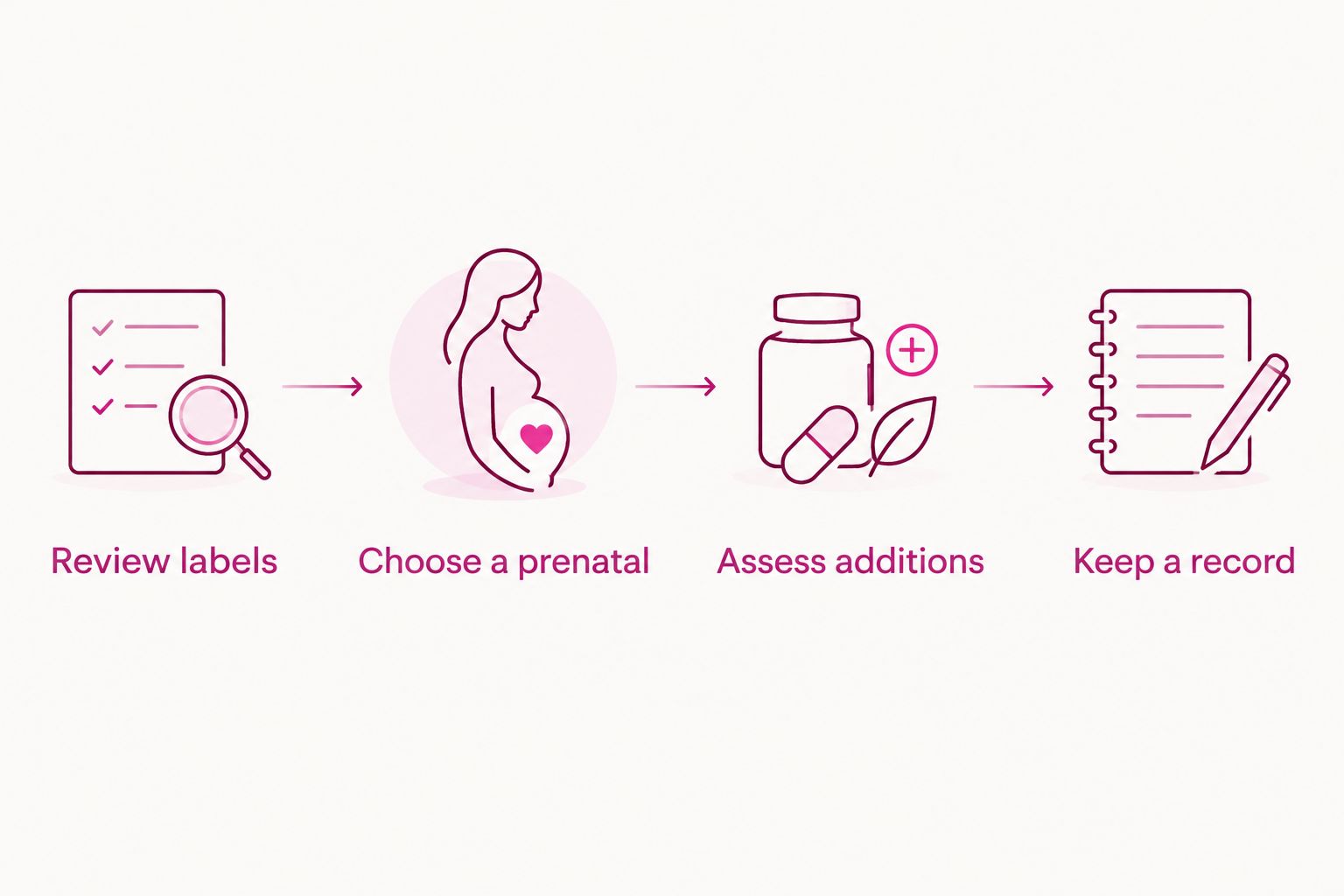
The process is simple: review what you have, choose a prenatal, assess additions, and keep your record current.
Compare ways to organize your supplement shelf
Choose the approach that answers your provider's recommendations with the least unnecessary complexity. These options describe ways to organize a plan, not a ranking of prenatal products.
| Option | Best for | Practical advantage | Key limitation |
|---|---|---|---|
| One provider-reviewed prenatal | Women who want a clear starting point | Keeps the main product and its directions easy to identify | Requires a review of how the formula fits your diet and needs |
| Prenatal plus a specific addition | Women whose provider recommends an extra nutrient | Gives the addition a defined purpose | Requires a check of combined nutrient amounts |
| Another prenatal format | Women who find their current format difficult to use | Lets you discuss a different daily routine | A format change still requires a full label comparison |
| A grouped supplement regimen | Women who want to review several products together | Puts multiple product choices into one conversation | Each component still needs individual review |
Pink Stork's Pregnancy Regimen includes Total Prenatal + DHA, Prenatal Probiotic, and Total Monolaurin. That grouping identifies the products, but it does not establish that every component belongs in your personal plan. Review the full set with your healthcare provider before a purchase.
Common mistakes with pregnancy must haves
Treat every pregnancy product as essential
A pregnancy-focused name does not make a product necessary for every woman. Start with your care plan, then decide which purchases serve it. You do not need to copy someone else's shelf to take your own needs seriously.
Compare front labels instead of full servings
A bottle's front panel cannot show every detail you need. Read the full serving size, nutrient amounts, ingredient list, and directions before you compare options. Keep a photograph if the text is hard to read at an appointment.
Carry over a pre-pregnancy routine without review
Products you used before pregnancy still need a new conversation. Include fertility supplements, herbal blends, and occasional wellness products in that review. Familiarity is not a substitute for pregnancy-specific guidance.
Choose convenience without checking the whole plan
A bundle or different format can simplify a purchase, but it does not remove the need to assess its ingredients. For your 2026 supplement shelf, convenience should follow the plan, not determine it.
FAQ
What are the pregnancy must haves for a simple supplement shelf?
Start with a provider-reviewed prenatal plan, the current product label, and a clear record of what you take. Add separate products only when your healthcare provider identifies a reason for them.
Is one prenatal vitamin enough during pregnancy?
Whether one prenatal is enough depends on the formula, your diet, and your individual needs. Ask your healthcare provider to review the label before you add separate nutrients.
How do I know whether Total Prenatal + DHA fits my needs?
Review the current Total Prenatal + DHA label with your healthcare provider. Confirm the serving instructions, ingredient list, and how the product fits with your food intake and other supplements.
Should I take a gummy, liquid, or capsule prenatal?
Choose a format you can take as directed after your healthcare provider reviews its formula. Compare complete labels rather than assume different formats contain the same nutrients or amounts.
Do I need separate iron or choline during pregnancy?
Your healthcare provider should determine whether separate iron or choline belongs in your plan. Review your prenatal's amounts and relevant food sources before you add another product.
Can I keep my fertility supplements once I am pregnant?
Have your healthcare provider review fertility supplements when you become pregnant. Do not assume a product intended for the pre-pregnancy stage should remain part of your pregnancy routine.
What should I do if I cannot tolerate my prenatal routine?
Contact your prenatal care team for advice about the product, format, or directions. Do not increase a later serving or combine alternatives on your own.
One last thing
The most useful item beside your prenatal bottle is a current supplement list. It lets your healthcare provider see your full routine without relying on memory.
When you feel ready to choose, explore Pink Stork's prenatal options with that list beside you. Start with Total Prenatal + DHA and the questions that matter to your own pregnancy. You deserve a plan you understand, without pressure to fill every space on the shelf.
Related guides
- Understand prenatal vitamins with vitamin D
- Compare liquid prenatal vitamins for a pill-free routine
- Review choline in prenatal vitamins
† These statements have not been evaluated by the Food and Drug Administration. This product is not intended to diagnose, treat, cure, or prevent any disease. Always consult your healthcare provider before starting any new supplement, especially during pregnancy, breastfeeding, or while managing a medical condition. Keep out of reach of children.