

· By Editorial Team
Best cortisol-support supplements for women in 2026
Pink Stork Cortisol Complex is best for women whose first shopping priority is a formula described for stress management—not a promise to lower cortisol. This 2026 guide helps you compare Cortisol Complex, a probiotic option, and magnesium while separating product facts from general health guidance.
TL;DR
- Pink Stork Cortisol Complex is the closest match for a stress-management formula, not a verified cortisol-lowering treatment.
- The best cortisol supplement for women depends on health history, ingredients, and the reason for seeking stress support.
Why this matters
You deserve support when stress feels heavy. But feeling overwhelmed does not tell you whether your cortisol is high, and a supplement's name cannot answer that question either.
Cortisol is a hormone your body needs. The National Institute of Diabetes and Digestive and Kidney Diseases explains that cortisol helps regulate functions including metabolism and the stress response; excess cortisol associated with Cushing's syndrome requires medical evaluation.
Choose around a specific need, not the idea that all cortisol should be lowered. That distinction matters whether you are managing a demanding schedule, preparing for pregnancy, or adjusting to postpartum life.
For your 2026 shopping decision, keep two questions separate: what does the product actually contain, and what evidence supports using it for your situation? Neither a reassuring product name nor a long ingredient list answers both.
What makes the best cortisol supplement for women?
A useful comparison starts with criteria you can check. These matter more than an overall winner:
- Relevant purpose: Does the stated product purpose match the support you want?
- Readable ingredients: Can you identify the ingredients, amounts, serving size, and directions on the current label?
- Evidence fit: Does the research concern the actual ingredient and formulation, rather than an unrelated product?
- Personal suitability: Have you considered medications, health conditions, pregnancy, and breastfeeding?
- Routine overlap: Does the formula repeat nutrients or herbs already in your supplements?
- Clear limits: Does the description distinguish general support from treating a diagnosed condition?
You do not need the most complicated routine. Start with a clear question and make each ingredient earn its place.
Your options at a glance
These options serve different shopping purposes. The table compares their stated identity and practical limitations; it does not rank their ability to change cortisol.
| Option | Best for | What distinguishes it | Key limitation |
|---|---|---|---|
| Cortisol Complex | Reviewing a formula described for stress management | Listed ingredients include ashwagandha, chamomile, vitamin D, omega-3 DHA, folate, and vitamins B6 and B12 | Ingredient presence does not establish a cortisol-lowering effect for the complete formula |
| Cortisol Probiotic | Exploring a probiotic-labeled option | A separate product identified as a probiotic | The product name does not establish strains, benefits, or suitability |
| Magnesium Glycinate | Discussing a targeted magnesium supplement | Identified as a magnesium glycinate option | Magnesium supplementation is not the same as treating high cortisol |
The simplest distinction is between a multi-ingredient stress-support formula, a probiotic, and a nutrient-specific option. Do not treat them as interchangeable—or assume that combining them improves the result.
Cortisol Complex: best for a stress-management formula review
Pink Stork Cortisol Complex is described as a formula for stress management. Its listed ingredients include ashwagandha, chamomile, vitamin D, omega-3 DHA, folate, and vitamins B6 and B12.
That makes it the most directly relevant starting point in this comparison if you want to review a stress-support formula. It does not establish that the finished product lowers cortisol or that every ingredient is appropriate for you.
Cortisol Complex pros:
- Its stated purpose matches a stress-management shopping goal.
- Its description identifies several ingredients you can discuss with your clinician.
- A single formula lets you review the included ingredients together before deciding.
Cortisol Complex cons:
- A multi-ingredient formula requires checking more than one ingredient for interactions and overlap.
- Ashwagandha carries pregnancy, breastfeeding, and other health cautions.
- Research on individual ingredients does not prove the complete formula produces the same effects.
The National Center for Complementary and Integrative Health reports that some ashwagandha preparations have evidence related to stress and insomnia. It also identifies limitations in the research, potential medication interactions, and reports of liver injury.
NCCIH advises avoiding ashwagandha during pregnancy and not using it while breastfeeding. Those cautions concern the ingredient; they are not a clinical assessment of this particular product.
Best for: Women seeking a formula described for stress management who can review its complete label against their health history.
Verdict: Hold until the ingredient and medication check is complete. For a 2026 purchase, relevance is a reason to examine the formula—not a reason to skip that step.
Cortisol Probiotic: best for a probiotic-focused conversation
Cortisol Probiotic is a separate product, not another name for Cortisol Complex. Its probiotic identity makes it a different option to discuss if your interest includes digestive health.
A probiotic's usefulness depends on details such as its microorganisms and the health question being addressed. NCCIH's probiotic guidance explains that different types of probiotics can have different effects; a benefit associated with one type does not automatically apply to another.
Cortisol Probiotic pros:
- It is clearly distinguished from the multi-ingredient complex.
- It gives you a probiotic-specific option to investigate.
- Its label can anchor a focused discussion about strains and your intended use.
Cortisol Probiotic cons:
- A cortisol-related product name does not prove a cortisol-related benefit.
- Findings about other probiotics do not establish the effects of this product.
- People with serious underlying health conditions need particular care when considering probiotics.
Before choosing, read the current label for the strain identities, directions, and cautions. Ask whether evidence for those specific strains applies to your goal rather than assuming all probiotics provide the same support.
Best for: Women who specifically want to discuss a probiotic option rather than assume they need a multi-ingredient stress formula.
Verdict: Wait for a strain-specific review. Choose a probiotic for a defined reason, not because its name sounds like the answer to stress.
Magnesium Glycinate: best for a targeted nutrient discussion
Magnesium Glycinate is the nutrient-specific option in this comparison. That makes the shopping question narrower: do you need additional magnesium, and does this form fit your routine?
The NIH Office of Dietary Supplements explains that magnesium supports normal muscle and nerve function, among other roles. Those established functions do not make magnesium a proven treatment for excess cortisol.
Magnesium Glycinate pros:
- Its named nutrient gives you a specific intake question to discuss.
- Magnesium requirements have published reference values.
- You can compare the label's elemental magnesium amount with your other supplements.
Magnesium Glycinate cons:
- A magnesium product does not establish a cortisol-lowering benefit.
- Magnesium can interact with certain medicines, including some antibiotics and osteoporosis medicines.
- Additional magnesium requires particular caution with impaired kidney function.
For nonpregnant adult women, NIH lists a magnesium recommended dietary allowance of 310 mg per day at ages 19–30 and 320 mg per day at age 31 and older. These totals include food and supplements; they are not instructions to take that amount in a capsule.
NIH also lists an adult upper limit of 350 mg per day from supplements and medications, excluding magnesium naturally present in food. This is a safety reference, not a recommended starting dose, and clinician-directed treatment is a separate matter.
Best for: Women reviewing a specific magnesium need with their healthcare professional.
Verdict: Hold until you check total intake and medication timing. Do not choose magnesium solely because a cortisol-focused search brought you to it.
A practical check before your first purchase
Pink Stork sells women's health supplements across fertility, pregnancy, postpartum, and beyond. Your life stage still matters more than the fact that products share a brand.
Use this sequence to prepare for a conversation, not to diagnose yourself. You can save the label and a short list of questions on your phone.
Name your goal
Write down what you want help with in everyday language: difficulty settling at night, feeling overwhelmed, or a digestive concern. Include when it started and how it affects your day.
Avoid replacing that description with a self-diagnosis such as high cortisol. A clear account of your experience gives your healthcare professional something more useful to assess.
Review your label
Read the Supplement Facts panel, directions, and warnings for the exact product you are considering. Look for ingredient amounts, not just a list of familiar names.
Check elemental magnesium rather than assuming a compound's total weight equals its magnesium content. For a probiotic, record the strain names so the discussion concerns the actual product.
Check your routine
List your prenatal, multivitamin, individual nutrients, herbal supplements, teas, and medications. Include occasional products as well as daily ones.
Cortisol Complex lists folate and vitamins B6, B12, and D, so compare those nutrients with your existing routine. Repetition is something to evaluate, not an automatic reason to add more.
Ask your clinician
Bring the complete label and your routine list to your clinician or pharmacist. Ask whether the ingredients fit your health history and whether the symptoms need evaluation before a supplement purchase.
Get product-specific advice if you are pregnant, breastfeeding, or trying to conceive. A recommendation for one stage of life should not be carried into another without checking.
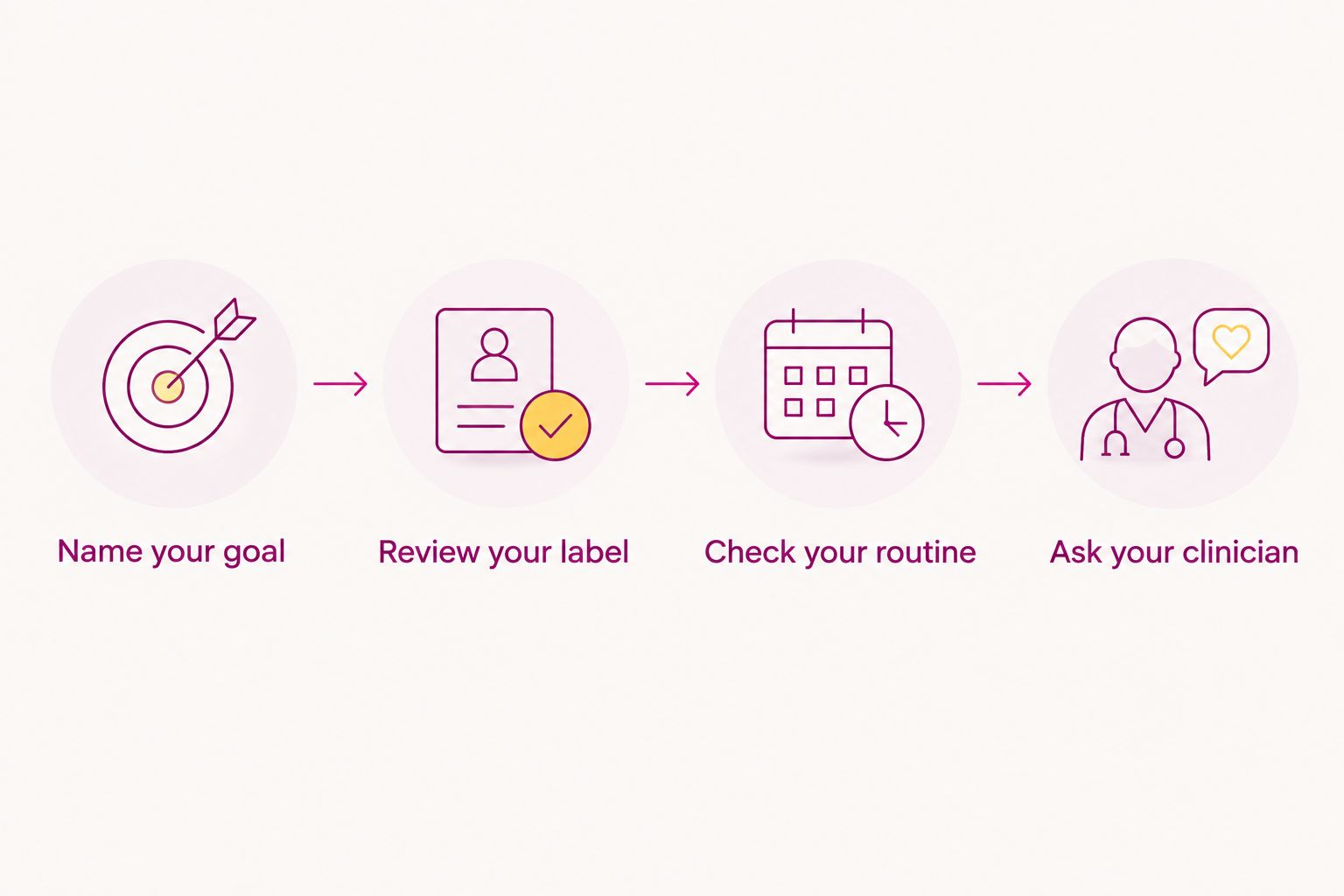
Once those questions are answered, you can return to the two cortisol-named options below. The cards identify the products; they do not establish which one is suitable for you.
Cortisol-support options to review

Includes ashwagandha, chamomile, vitamin D, omega-3 DHA, folate, and vitamins B6 and B12.

How these options were compared
This 2026 comparison uses stated product purpose, identified ingredients, personal suitability, and the limits of the available evidence. It does not claim head-to-head testing or rank competing brands.
General health guidance draws on NIH Office of Dietary Supplements magnesium reference values, NCCIH guidance on ashwagandha and probiotics, and NIDDK information about Cushing's syndrome. These sources address nutrients, ingredients, and health conditions—not endorsements of the products listed here.
A product fact and a clinical conclusion are different things. Knowing that a formula contains ashwagandha does not establish its effect on your cortisol, and knowing that magnesium is essential does not establish that you need a supplement.
Which option should you choose?
If your goal is to examine a formula specifically described for stress management, start your review with Cortisol Complex. If your question concerns probiotics or magnesium intake, keep that question specific instead of treating every option as cortisol support.
For women considering their first Pink Stork purchase, the best next move is a label review—not a larger supplement stack. Choose only after the product's purpose, ingredients, and cautions fit your situation.
Your 2026 decision does not need to be rushed. Skip any option whose ingredients or intended use you cannot explain to your healthcare professional.
FAQ
What's the best cortisol supplement for women?
There is no established universal best cortisol supplement for women. Pink Stork Cortisol Complex is the closest match in this comparison for reviewing a formula described for stress management, but suitability depends on its complete label and your health history.
Does Cortisol Complex lower cortisol?
Its listed ingredients and stress-management description do not establish that Cortisol Complex lowers cortisol. Evidence about individual ingredients should not be treated as proof of the finished formula's effects.
Is Cortisol Probiotic better than Cortisol Complex?
Neither product is established as better by this comparison. Cortisol Probiotic is a probiotic-labeled option, while Cortisol Complex lists several nutrients and herbs; choose around a defined need and product-specific evidence.
Can I take a cortisol supplement while pregnant or breastfeeding?
Do not assume a cortisol-support supplement is appropriate during pregnancy or breastfeeding. NCCIH advises avoiding ashwagandha during pregnancy and not using it while breastfeeding; Cortisol Complex lists ashwagandha among its ingredients.
Is magnesium glycinate a treatment for high cortisol?
Magnesium glycinate should not be treated as a proven treatment for high cortisol. Magnesium is an essential nutrient, but deciding whether you need additional magnesium is different from evaluating a suspected hormone disorder.
Can I combine cortisol support with my prenatal vitamin?
Do not combine them without reviewing both labels with your healthcare professional. Cortisol Complex lists nutrients also found in many prenatal formulas, and its ashwagandha content raises a separate pregnancy-related concern.
Should I get my cortisol checked before buying a supplement?
Ask your healthcare professional whether testing is appropriate rather than choosing a test or supplement yourself. Feeling stressed does not by itself establish high cortisol, and suspected excess cortisol needs medical evaluation.
One last thing
More ingredients can make a formula harder to evaluate, not automatically more useful. For a thoughtful 2026 purchase, take a photo of the complete label and put it beside your current supplement list before you decide.
Support can include practical care, trusted people, and space for prayer if that is meaningful to you. You do not have to turn every difficult season into another supplement purchase.


